Integrate Edge AI: 6-Step Guide for US Companies 2025

Integrating Edge AI into operations by 2025 is crucial for US companies seeking real-time data processing, reduced latency, and enhanced operational efficiency across various sectors.
In an increasingly data-driven world, the ability to process information at its source is no longer a luxury but a strategic imperative. For US companies navigating the complexities of 2025, understanding how to integrate Edge AI into your operations is paramount. This guide will walk you through a comprehensive 6-step process, designed to empower your organization to harness the transformative power of Edge AI, driving efficiency, innovation, and competitive advantage.
Understanding Edge AI and Its Strategic Importance for US Businesses
Edge AI refers to the deployment of artificial intelligence algorithms directly on devices at the edge of a network, rather than relying solely on centralized cloud infrastructure. This approach allows for real-time data processing, reduced latency, and enhanced privacy, making it a critical technology for modern US businesses. The strategic importance lies in its capacity to transform industries from manufacturing and healthcare to retail and logistics, enabling faster decision-making and more efficient operations.
By bringing AI capabilities closer to the data source, companies can minimize the need to transmit vast amounts of raw data to the cloud, significantly cutting bandwidth costs and improving response times. This decentralization of intelligence is particularly beneficial in environments where connectivity is unreliable or bandwidth is limited, ensuring continuous operation and immediate insights.
The foundational shift to decentralized intelligence
The transition from cloud-centric AI to Edge AI represents a fundamental shift in how businesses manage and leverage their data. This paradigm allows for greater autonomy at the device level, fostering resilience and enabling new applications that were previously impractical due to latency constraints.
- Reduced Latency: Real-time decision-making for critical applications.
- Enhanced Privacy: Data processed locally, minimizing exposure.
- Lower Bandwidth Costs: Less data transmitted to the cloud.
- Increased Reliability: Operations continue even with intermittent connectivity.
The adoption of Edge AI positions US companies at the forefront of technological innovation, providing a robust framework for next-generation applications and services. This strategic move not only optimizes existing processes but also unlocks new avenues for business growth and customer engagement.
Step 1: Assessing Your Operational Needs and Identifying Use Cases
The first critical step in integrating Edge AI is a thorough assessment of your company’s current operational needs and identifying specific use cases where Edge AI can deliver significant value. This involves a deep dive into existing workflows, pinpointing bottlenecks, and understanding data generation points. Without a clear understanding of where Edge AI can make the biggest impact, efforts can be misdirected and resources wasted.
Begin by engaging with various departments, from operations and IT to sales and customer service, to gather diverse perspectives on challenges and opportunities. Look for areas where immediate data processing, predictive analytics, or autonomous decision-making would be highly beneficial. This initial phase is about asking the right questions and mapping out potential applications.
Pinpointing high-impact areas for Edge AI implementation
Once potential areas are identified, prioritize them based on feasibility, potential ROI, and alignment with strategic business objectives. Not all problems require an Edge AI solution, and it’s essential to differentiate between problems that can be solved with traditional cloud AI and those that genuinely benefit from edge processing.
- Manufacturing: Predictive maintenance, quality control, robot guidance.
- Retail: Inventory management, customer behavior analysis, personalized experiences.
- Healthcare: Remote patient monitoring, real-time diagnostics, asset tracking.
- Logistics: Route optimization, fleet management, autonomous vehicles.
A well-defined use case includes a clear problem statement, measurable objectives, and an understanding of the data sources and computational requirements. This foundational step ensures that subsequent integration efforts are focused and deliver tangible results, laying the groundwork for a successful Edge AI deployment.
Step 2: Developing a Robust Edge AI Strategy and Architecture
With identified use cases, the next crucial step is to develop a comprehensive Edge AI strategy and design a suitable architecture. This involves selecting the right hardware, software platforms, and connectivity solutions that align with your operational needs and budget. A well-thought-out strategy ensures scalability, security, and interoperability across your distributed network.
Consider the types of edge devices required, ranging from powerful edge servers to low-power sensors, and how they will interact with each other and with your central cloud infrastructure. The architecture must support the deployment, management, and continuous optimization of AI models at the edge, ensuring seamless operation and data flow.
Key components of an effective Edge AI architecture
An effective Edge AI architecture is not just about individual components; it’s about how these components integrate to form a cohesive and resilient system. This includes careful consideration of data governance, security protocols, and the lifecycle management of AI models deployed at the edge.
- Edge Devices: Sensors, cameras, gateways, micro-servers.
- Edge AI Software: Runtime environments, inference engines, model optimization tools.
- Connectivity Solutions: 5G, Wi-Fi 6, LoRaWAN, satellite for reliable data transfer.
- Cloud Integration: Seamless data synchronization and model updates from a central cloud.
Developing this strategy requires collaboration between IT, operations, and data science teams to ensure all technical and business requirements are met. A robust architecture provides the blueprint for a successful Edge AI implementation, minimizing risks and maximizing the potential for innovation.
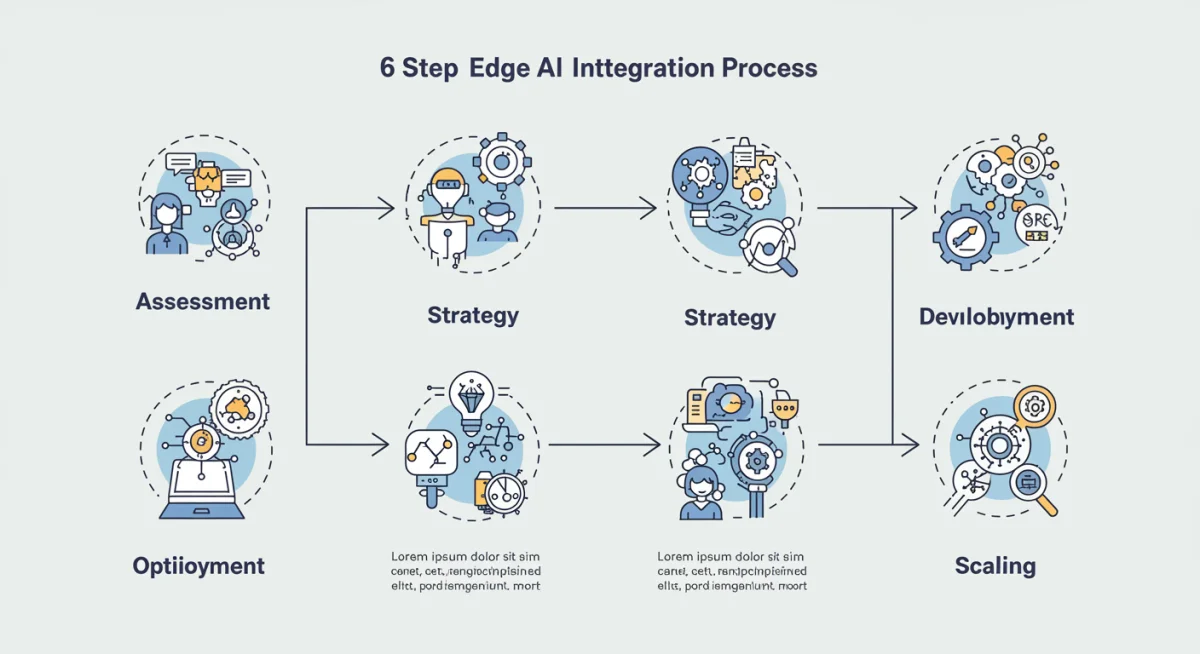
Step 3: Piloting and Prototyping Edge AI Solutions
Before a full-scale deployment, it is essential to pilot and prototype your Edge AI solutions. This step allows companies to test the chosen technologies, validate use cases, and identify any unforeseen challenges in a controlled environment. A pilot program helps refine the architecture, optimize model performance, and ensure that the solution meets the defined objectives.
Start with a small, manageable project that represents a critical use case. This could involve deploying a few edge devices in a specific area of your facility or testing a single AI model on a limited dataset. The goal is to gather real-world data, evaluate performance metrics, and iterate on the design based on feedback.
Iterative development and performance validation
Prototyping involves an iterative process of development, testing, and refinement. This stage is crucial for debugging issues, optimizing the efficiency of AI models on edge hardware, and ensuring that the data flow is robust and secure. Performance validation includes assessing latency, accuracy, power consumption, and overall system reliability.
- Small-scale Deployment: Test in a controlled, limited environment.
- Data Collection & Analysis: Gather real-world data for model refinement.
- Performance Benchmarking: Evaluate latency, accuracy, and resource utilization.
- Feedback Loop: Incorporate insights from pilot users and technical teams.
A successful pilot demonstrates the feasibility and value of Edge AI, building internal confidence and securing buy-in for broader deployment. It provides valuable lessons that can be applied to scale the solution efficiently and effectively, minimizing risks associated with large-scale implementation.
Step 4: Full-Scale Deployment and Integration with Existing Systems
Once the pilot phase has validated the Edge AI solution, the next step is full-scale deployment and seamless integration with your existing operational systems. This involves rolling out edge devices across your target environment, deploying optimized AI models, and ensuring robust connectivity and data synchronization. Successful integration requires careful planning and coordination to minimize disruption to ongoing operations.
This stage often involves significant logistical challenges, including device procurement, installation, and configuration across multiple locations. It also requires establishing secure communication channels between edge devices, local servers, and cloud platforms, ensuring data integrity and compliance with regulatory standards.
Ensuring seamless operation and data flow
Integration with existing enterprise resource planning (ERP), manufacturing execution systems (MES), or customer relationship management (CRM) systems is critical for maximizing the value of Edge AI. This allows the insights generated at the edge to inform broader business decisions and automate workflows.
- Phased Rollout: Deploy in stages to manage complexity and risk.
- Secure Connectivity: Implement robust network security protocols.
- System Integration: Connect Edge AI insights with core business systems.
- Employee Training: Educate staff on new tools and processes.
A well-executed deployment ensures that Edge AI becomes an integral part of your operational fabric, delivering continuous value and driving sustained improvements. This step transforms the pilot project into a fully operational and impactful solution across the enterprise.
Step 5: Optimizing Performance and Continuous Monitoring
Deployment is not the end goal; continuous optimization and monitoring are essential to ensure Edge AI solutions maintain peak performance and adapt to evolving operational requirements. This involves regularly reviewing model accuracy, device health, and network performance, making adjustments as needed. The dynamic nature of business environments and data patterns necessitates an agile approach to Edge AI management.
Implement robust monitoring tools that provide real-time insights into the performance of your edge devices and AI models. This includes tracking key metrics such as inference speed, energy consumption, and data transfer rates. Proactive monitoring helps identify potential issues before they impact operations, ensuring high availability and reliability.
Maintaining peak efficiency and adapting to change
Optimization efforts can include retraining AI models with new data, upgrading edge device firmware, or fine-tuning network configurations. The goal is to maximize efficiency, reduce operational costs, and enhance the overall effectiveness of your Edge AI deployment. This iterative process ensures that the solution remains relevant and valuable over time.
- Real-time Monitoring: Track device health, model performance, and data flow.
- Model Retraining: Update AI models with new data to maintain accuracy.
- Firmware Updates: Ensure edge devices are running the latest, most secure software.
- Performance Tuning: Adjust configurations to optimize speed and efficiency.
Through continuous optimization and monitoring, US companies can ensure their Edge AI investments deliver sustained value, adapting to new challenges and opportunities as they arise. This proactive approach safeguards the long-term success of Edge AI initiatives.
Step 6: Scaling Edge AI Across the Enterprise and Fostering Innovation
The final step in integrating Edge AI is scaling the successful solutions across the entire enterprise and fostering a culture of continuous innovation. Once initial deployments have proven their worth, the focus shifts to expanding the reach of Edge AI to other departments, regions, or product lines. This strategic expansion multiplies the benefits and reinforces the company’s competitive edge.
Scaling requires a well-defined strategy for managing a growing number of edge devices, AI models, and data streams. It also involves establishing best practices, standardizing deployment processes, and developing internal expertise to support the expanded infrastructure. Fostering innovation means encouraging employees to identify new applications and solutions leveraging Edge AI.
Expanding impact and driving future growth
To successfully scale, companies should invest in platforms that simplify the management of distributed Edge AI systems, allowing for centralized control and automated updates. This reduces the operational overhead and ensures consistency across the enterprise. Furthermore, promoting a culture that embraces experimentation and continuous learning is vital for unlocking the full potential of Edge AI.
- Centralized Management: Use platforms for unified control of edge devices and models.
- Standardized Deployments: Create repeatable processes for rapid expansion.
- Internal Expertise: Develop or acquire skills for Edge AI development and maintenance.
- Innovation Culture: Encourage exploration of new Edge AI applications.
By scaling Edge AI effectively and nurturing an innovative environment, US companies can build a future-proof operational backbone that drives efficiency, unlocks new revenue streams, and maintains a leading position in a rapidly evolving technological landscape.
| Key Step | Brief Description |
|---|---|
| Assess Needs | Identify specific operational bottlenecks and high-value Edge AI use cases. |
| Develop Strategy | Design architecture, select hardware/software, and plan connectivity. |
| Pilot Solutions | Test, prototype, and validate Edge AI solutions in a controlled environment. |
| Scale & Innovate | Expand Edge AI across the enterprise and foster continuous innovation. |
Frequently Asked Questions About Edge AI Integration
Edge AI processes data at the source, reducing latency and bandwidth use. For US companies, this means faster real-time decision-making, enhanced data privacy, and improved operational resilience, especially in sectors like manufacturing, healthcare, and smart cities.
Key benefits include real-time insights for immediate action, lower operational costs by minimizing cloud data transfer, improved security through local data processing, and consistent performance even with intermittent network connectivity. It also enables new applications.
Challenges involve managing diverse edge devices, optimizing AI models for limited compute resources, ensuring robust security in distributed environments, and integrating with legacy systems. Scalability and maintaining consistent performance across various locations are also significant hurdles.
Companies should implement strong encryption, secure boot processes, and regular security audits for edge devices. Local data processing reduces the need to send sensitive information to the cloud, inherently enhancing privacy. Compliance with regulations like GDPR and CCPA is also crucial.
A successful team requires expertise in machine learning, embedded systems, network engineering, and cybersecurity. Data scientists, hardware engineers, and cloud architects are essential. Continuous learning and cross-functional collaboration are also vital for staying current with evolving technologies.
Conclusion
Successfully integrating Edge AI into your operations by 2025 is a multifaceted endeavor that promises significant returns for US companies. By following this 6-step guide, from initial assessment to continuous scaling and innovation, businesses can strategically deploy Edge AI to gain real-time insights, optimize processes, and secure a competitive advantage. The future of operational efficiency and intelligent automation lies at the edge, and proactive adoption will define market leaders in the coming years.