Quantum Cryptography: US Data Protection in 2025
Quantum cryptography will be essential for protecting US data from future threats by 2025, leveraging quantum mechanics to ensure inherently secure communication channels against increasingly sophisticated cyber-attacks.
The digital landscape is constantly evolving, bringing forth both unprecedented opportunities and sophisticated threats. As we approach 2025, the imperative to secure sensitive information in the United States against emerging vulnerabilities, particularly from quantum computing advancements, has become paramount. This is where quantum cryptography US strategies are stepping into the spotlight, promising a new era of impenetrable data protection.
Understanding the Quantum Threat and Opportunity
The advent of quantum computing, while offering immense computational power for scientific breakthroughs, also poses an existential threat to current cryptographic standards. Traditional encryption methods, based on mathematical problems too complex for classical computers, could be easily broken by sufficiently powerful quantum machines. This looming threat necessitates a fundamental shift in how we secure our digital infrastructure and sensitive data.
However, quantum mechanics doesn’t just present a problem; it also offers a solution. Quantum cryptography harnesses the very principles of quantum physics to create communication channels that are provably secure. Unlike classical cryptography, which relies on computational difficulty, quantum cryptography’s security is based on the fundamental laws of nature, making it theoretically impervious to even quantum-powered decryption attempts.
The Inherent Security of Quantum Mechanics
At its core, quantum cryptography leverages phenomena like superposition and entanglement to ensure that any attempt to intercept a quantum key is immediately detectable. This ‘eavesdropping’ attempt inevitably disturbs the quantum state, alerting the communicating parties and rendering the intercepted key useless. This fundamental principle provides an unparalleled level of security.
- Superposition: Qubits can exist in multiple states simultaneously.
- Entanglement: Two or more qubits become linked, sharing the same fate regardless of distance.
- No-Cloning Theorem: It’s impossible to create an identical copy of an unknown quantum state.
By understanding both the destructive potential of quantum computers against current encryption and the protective power of quantum cryptography, the US can proactively build resilient systems. The focus is shifting from merely reacting to threats to anticipating and neutralizing them by integrating quantum-safe solutions into critical national infrastructure and communication networks.
Quantum Key Distribution (QKD): The Foundation of Quantum Security
Quantum Key Distribution (QKD) is the most mature and widely discussed application of quantum cryptography. QKD protocols enable two parties, typically referred to as Alice and Bob, to establish a shared, secret cryptographic key whose security is guaranteed by the laws of quantum physics. This key can then be used with classical encryption algorithms to secure data transmission.
The beauty of QKD lies in its ability to detect any eavesdropping attempt. If an adversary, Eve, tries to intercept the photons carrying the quantum key, she inevitably alters their quantum state. This alteration is then statistically detectable by Alice and Bob during the key reconciliation process, allowing them to discard the compromised key and generate a new one. This fundamental principle ensures that a shared secret key can be established with absolute certainty of its integrity.
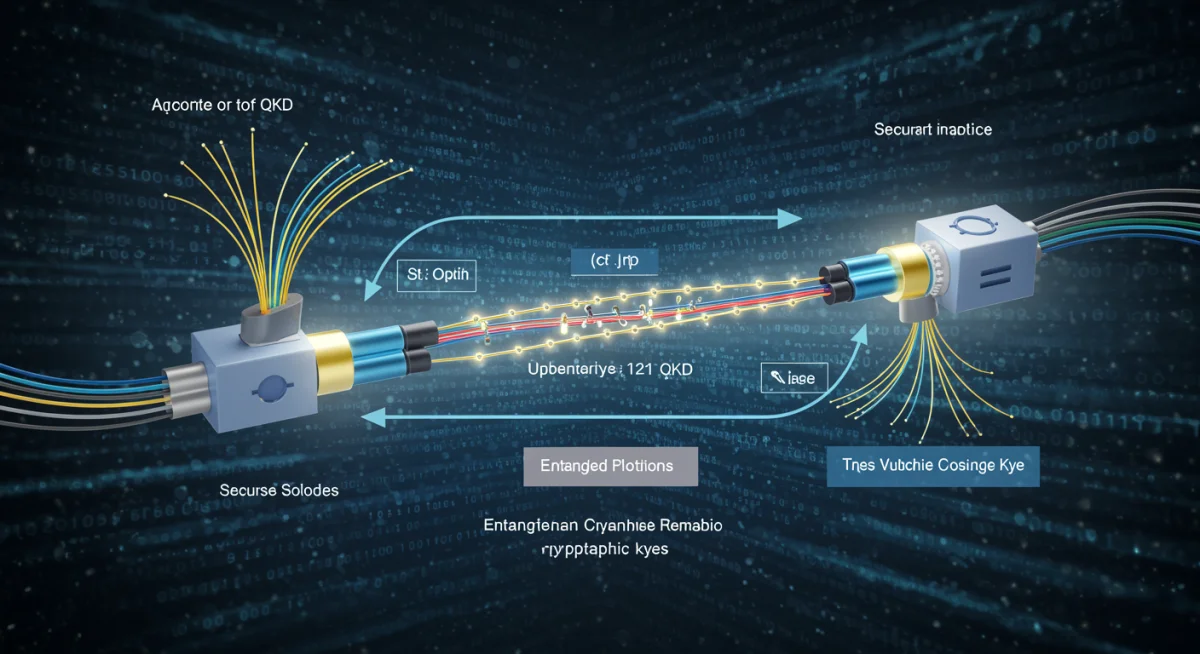
Several QKD protocols exist, with BB84 being the most well-known. These protocols typically involve transmitting single photons, whose polarization or phase encodes the bits of the key. The random nature of quantum measurements and the no-cloning theorem prevent an eavesdropper from gaining any useful information without leaving a detectable trace.
How QKD Works in Practice
Implementing QKD involves specialized hardware, including single-photon detectors and photon sources. While the theoretical security is robust, practical implementations face challenges such as distance limitations due to photon loss in fiber optic cables and the need for dedicated infrastructure. However, significant progress is being made to overcome these hurdles, with satellite-based QKD offering solutions for long-distance communication.
- Photon Generation: Alice sends individual photons encoding random bits.
- Quantum Channel: Photons travel through an optical fiber or free space.
- Measurement: Bob measures the photons, randomly choosing measurement bases.
- Key Reconciliation: Alice and Bob publicly discuss their choices of bases to identify matching ones.
- Privacy Amplification: Any potential partial information gained by Eve is eliminated.
The integration of QKD into existing communication networks is a complex but crucial step for protecting critical US data. As the technology matures, we can expect to see QKD deployments in sensitive government communications, financial transactions, and critical infrastructure control systems, forming the bedrock of future cyber defenses.
Post-Quantum Cryptography (PQC): A Complementary Approach
While QKD provides a quantum-secure method for key exchange, it is primarily focused on securing the communication channel itself. Post-Quantum Cryptography (PQC), also known as quantum-resistant cryptography, takes a different but complementary approach. PQC refers to cryptographic algorithms that are designed to be secure against attacks by both classical and quantum computers, without relying on quantum mechanical principles for their security.
These algorithms are essentially classical cryptographic schemes that are believed to be hard to break even for quantum computers. The development of PQC is crucial because many existing cryptographic protocols, such as RSA and ECC, are vulnerable to Shor’s algorithm, which can efficiently factor large numbers or solve elliptic curve discrete logarithm problems on a quantum computer. PQC aims to replace these vulnerable algorithms with new ones that resist quantum attacks.
The National Institute of Standards and Technology (NIST) in the US has been leading a multi-year standardization process for PQC algorithms, evaluating various candidates across different categories like lattice-based cryptography, code-based cryptography, and multivariate polynomial cryptography. This standardization effort is vital for ensuring interoperability and widespread adoption of quantum-resistant solutions.
Key Areas of PQC Research and Development
The research into PQC is diverse, exploring various mathematical problems that are thought to be difficult for quantum computers to solve. This includes problems in linear algebra over finite fields, coding theory, and the geometry of numbers. The goal is to find algorithms that are both efficient enough for practical use and demonstrably resistant to quantum attacks.
- Lattice-based Cryptography: Relies on the difficulty of solving certain problems in high-dimensional lattices.
- Code-based Cryptography: Based on error-correcting codes, often utilizing McEliece or Niederreiter cryptosystems.
- Multivariate Polynomial Cryptography: Uses systems of multivariate polynomial equations over finite fields.
The strategic implementation of PQC alongside QKD forms a robust, multi-layered defense strategy for US data. PQC can secure stored data, digital signatures, and authentication protocols, whereas QKD provides an unassailable method for real-time key exchange. Together, they address the full spectrum of cryptographic vulnerabilities in a quantum-threat landscape.
Challenges and Roadblocks to Quantum Cryptography Adoption
Despite the immense promise of quantum cryptography, its widespread adoption in the US faces several significant challenges. These are not merely technical hurdles but also encompass economic, logistical, and educational aspects that need to be addressed for a successful transition to a quantum-secure future by 2025 and beyond.
One of the primary technical challenges for QKD is its limited range and the need for line-of-sight or dedicated fiber optic infrastructure. While satellite-based QKD offers a solution for long distances, it introduces its own complexities and costs. Furthermore, integrating QKD systems into existing classical networks requires significant architectural changes and interoperability standards, which are still under development.
For PQC, the main challenge lies in the fact that these algorithms are relatively new and have not undergone the extensive cryptanalysis that classical algorithms like RSA have. There’s a continuous need for rigorous testing and validation to ensure their long-term security. Additionally, PQC algorithms often have larger key sizes and computational overhead compared to their classical counterparts, which can impact performance and require hardware upgrades.
Overcoming Implementation Barriers
The economic investment required for quantum cryptography infrastructure is substantial. Developing, deploying, and maintaining QKD networks and upgrading systems to support PQC will demand significant financial resources from both government and private sectors. This investment must be justified by the perceived value of enhanced security.
- High Cost: Initial investment in quantum hardware and infrastructure.
- Interoperability: Seamless integration with legacy systems.
- Standardization: Establishing universally accepted protocols and algorithms.
- Skilled Workforce: Training cybersecurity professionals in quantum-safe methods.
Addressing these challenges requires a concerted effort from researchers, industry, and government. Strategic investments in R&D, the development of clear standards, and comprehensive educational programs are all critical steps towards overcoming these roadblocks and ensuring the timely adoption of quantum cryptography solutions for US data protection.
US Government Initiatives and Strategic Outlook for 2025
Recognizing the critical importance of quantum cryptography for national security and economic stability, the US government has launched several significant initiatives to accelerate its development and deployment. These efforts reflect a proactive stance, aiming to position the US as a leader in quantum-safe technologies by 2025.
Key agencies like the National Institute of Standards and Technology (NIST), the National Security Agency (NSA), and the Department of Defense (DoD) are at the forefront of this endeavor. NIST’s PQC standardization process is a cornerstone, providing a framework for developing and evaluating quantum-resistant algorithms that will eventually replace current vulnerable cryptographic standards across federal agencies and critical infrastructure. This process involves collaboration with academic institutions and private companies globally.
Beyond PQC, there’s a growing emphasis on quantum key distribution (QKD) research and pilot programs. The US government is exploring the feasibility of deploying QKD networks for highly sensitive communications, particularly in areas related to defense, intelligence, and critical infrastructure. These pilot projects aim to identify practical implementation challenges and develop best practices for future large-scale deployments.
Legislative and Policy Directives
Recent legislative actions, such as the Quantum Computing Cybersecurity Preparedness Act, underscore the government’s commitment. This act mandates federal agencies to inventory their cryptographic systems and transition to PQC-compliant solutions, setting a clear directive for the modernization of federal cybersecurity infrastructure. Such policies provide a strong impetus for both public and private sectors to prioritize quantum readiness.
- NIST PQC Standardization: Leading global efforts to identify quantum-resistant algorithms.
- Federal Agency Mandates: Directing government entities to transition to quantum-safe encryption.
- R&D Funding: Investing in academic and industrial research for quantum technologies.
- International Collaboration: Working with allies to establish global quantum security standards.
By 2025, the US aims to have a robust roadmap for transitioning to quantum-safe cryptography, with initial deployments of PQC algorithms in critical systems and continued advancements in QKD technologies. This strategic outlook is designed to ensure the nation’s digital resilience against both current and future quantum threats, safeguarding sensitive data and maintaining a competitive edge in the global technological landscape.
The Future of Secure Communication: Beyond 2025
While 2025 serves as a critical milestone for the initial adoption of quantum cryptography, the journey towards a fully quantum-secure communication ecosystem extends far beyond. The landscape of cybersecurity is dynamic, and continuous innovation will be essential to stay ahead of evolving threats. The future envisions a hybrid approach where quantum and classical cryptographic methods coexist, each playing a vital role in a layered security architecture.
Research and development will continue to push the boundaries of quantum technology, leading to more efficient, cost-effective, and scalable QKD systems. We can anticipate advancements in quantum repeaters to extend QKD distances, as well as the development of quantum internet prototypes that could enable globally distributed quantum networks. These networks would not only facilitate ultra-secure communication but also unlock new possibilities for distributed quantum computing and sensing.
For Post-Quantum Cryptography, ongoing cryptanalysis and the emergence of new mathematical insights will refine the selection of standardized algorithms. It’s a continuous process of discovery and validation, ensuring that the chosen PQC schemes remain secure against any unforeseen quantum algorithmic breakthroughs. Furthermore, the integration of PQC into everyday devices and software will become increasingly seamless, making quantum-resistant security ubiquitous.
Emerging Quantum Security Paradigms
Beyond QKD and PQC, emerging fields like quantum random number generation (QRNG) are also gaining traction. QRNG devices harness quantum mechanics to produce truly random numbers, which are crucial for generating strong cryptographic keys. Traditional random number generators often rely on pseudo-random processes, which can be predictable; QRNG offers an inherently unpredictable source of randomness, enhancing overall security.
- Quantum Internet: Global network enabling quantum-secure communication and distributed quantum computing.
- Quantum Random Number Generation (QRNG): Providing truly unpredictable numbers for cryptographic keys.
- Quantum-Resistant Hardware: Development of hardware designed to implement PQC efficiently and securely.
- Automated Quantum Security Management: Systems for monitoring and managing quantum-safe cryptographic assets.
The long-term vision is to create a resilient digital infrastructure where data integrity and confidentiality are guaranteed by the fundamental laws of physics. This future will require continuous investment in research, a robust talent pipeline of quantum-savvy professionals, and strong international collaboration to address global cyber threats. The US commitment to quantum cryptography today lays the groundwork for a more secure tomorrow.
| Key Aspect | Brief Description |
|---|---|
| Quantum Threat | Quantum computers can break current encryption methods like RSA and ECC, posing a significant risk to US data. |
| Quantum Key Distribution (QKD) | Uses quantum physics to create provably secure encryption keys, detecting any eavesdropping attempt. |
| Post-Quantum Cryptography (PQC) | Classical algorithms designed to resist attacks from both classical and quantum computers, standardizing for future use. |
| US Strategic Outlook | Government initiatives, R&D funding, and legal mandates accelerate adoption of quantum-safe solutions by 2025. |
Frequently Asked Questions about Quantum Cryptography
Quantum cryptography uses principles of quantum mechanics to secure communications. Its primary advantage is the ability to detect any attempt at eavesdropping, ensuring that cryptographic keys are exchanged with provable security, unlike traditional methods vulnerable to quantum computing.
It protects US data by enabling the creation of unbreakable encryption keys through Quantum Key Distribution (QKD) and by developing Post-Quantum Cryptography (PQC) algorithms resistant to quantum computer attacks. These methods secure sensitive government, military, and financial information from future threats.
QKD (Quantum Key Distribution) uses quantum physics for secure key exchange, guaranteeing eavesdropping detection. PQC (Post-Quantum Cryptography) involves classical algorithms designed to resist attacks from quantum computers, securing data at rest and digital signatures.
Key challenges include high implementation costs, limited range for QKD, the need for new infrastructure, and the complexity of integrating quantum-safe solutions into existing systems. Standardization and developing a skilled workforce are also critical hurdles.
The US government, through NIST and other agencies, is leading PQC standardization, funding R&D, and implementing policies like the Quantum Computing Cybersecurity Preparedness Act. These initiatives aim to accelerate the transition to quantum-resistant encryption across federal and critical infrastructure.
Conclusion
The landscape of cybersecurity is on the cusp of a revolutionary transformation, driven by the dual challenge and promise of quantum technology. By 2025, the proactive adoption of quantum cryptography US strategies will be non-negotiable for safeguarding national data and critical infrastructure against emergent quantum threats. The combined strengths of Quantum Key Distribution and Post-Quantum Cryptography, supported by robust government initiatives and sustained research, are laying the groundwork for an unparalleled era of digital security. While challenges remain, the strategic vision and concerted efforts position the US to lead in this crucial domain, ensuring a resilient and secure digital future.