Generative AI in Software: Top 5 Tools for US Tech Teams in 2025

Generative AI is revolutionizing software development by automating complex tasks and enhancing creativity, with 5 key tools set to profoundly impact US tech teams by 2025.
The landscape of technology is in constant flux, and few forces are shaping its future as profoundly as generative artificial intelligence. The impact of Generative AI Software Development is not a distant concept but a present reality, rapidly accelerating innovation and efficiency within US tech teams. This article delves into the core of this transformation, highlighting five critical tools that are poised to redefine how software is built, tested, and deployed by 2025.
The AI Revolution in Code Generation
Generative AI’s ability to produce human-like text has seamlessly extended into generating code, fundamentally changing the initial stages of software development. This isn’t merely about auto-completion; it’s about AI understanding context, intent, and best practices to draft significant portions of an application. For US tech teams, this translates into unprecedented acceleration in project timelines and a significant reduction in boilerplate code.
The benefits of AI in code generation are multifaceted. Developers can offload repetitive tasks, allowing them to focus on more complex architectural challenges and innovative solutions. This shift elevates the role of the developer from a pure coder to more of an architect and problem-solver, leveraging AI as a powerful assistant rather than a replacement.
Automating Boilerplate and Routine Tasks
One of the most immediate impacts of generative AI is the automation of boilerplate code. This includes setting up basic structures, creating API endpoints, and configuring database schemas. These tasks, while essential, consume valuable developer time that could be better spent on core logic and unique features.
- Accelerates initial project setup significantly.
- Reduces the likelihood of human error in repetitive coding.
- Frees up developers for higher-value activities.
- Ensures consistency in coding standards across projects.
Looking ahead, the integration of generative AI into integrated development environments (IDEs) will become even more seamless. Tools will not only suggest code but actively participate in refactoring, debugging, and even optimizing performance, making the development process inherently more efficient and less prone to common pitfalls. The human element will shift towards guiding the AI, validating its outputs, and injecting unique creative solutions.
Intelligent Debugging and Error Resolution
Beyond generating code, generative AI is proving invaluable in the often-tedious process of debugging and error resolution. Traditional debugging can be a time-consuming endeavor, requiring developers to meticulously trace code paths and understand complex system interactions. AI, with its pattern recognition capabilities, can significantly streamline this process.
By analyzing vast amounts of code and error logs, generative AI tools can identify potential issues before they manifest as critical bugs. They can also suggest immediate fixes or point developers to the exact location of a problem, drastically cutting down the time spent on troubleshooting. This capability is paramount for maintaining high-quality software and accelerating release cycles.
Predictive Error Identification
Generative AI excels at predictive error identification. By learning from past codebases and common error patterns, these tools can flag potential vulnerabilities or logical inconsistencies as code is being written. This proactive approach prevents bugs from even entering the testing phase, saving significant resources.
- Identifies common coding mistakes and anti-patterns.
- Suggests robust solutions based on historical data.
- Reduces the overall number of bugs in production.
- Improves code quality and maintainability.
The evolution of AI in debugging will eventually lead to self-healing code, where systems can autonomously identify and correct minor errors without human intervention. While full autonomy is still some way off, the current trajectory suggests a future where AI acts as an omnipresent guardian, ensuring code integrity and system stability around the clock.
Automated Testing and Quality Assurance
Quality assurance (QA) is a critical bottleneck in many software development cycles. Manual testing is slow, expensive, and prone to human oversight, while traditional automated testing requires significant effort to set up and maintain. Generative AI is transforming QA by automating the creation of test cases, test data, and even entire test suites.
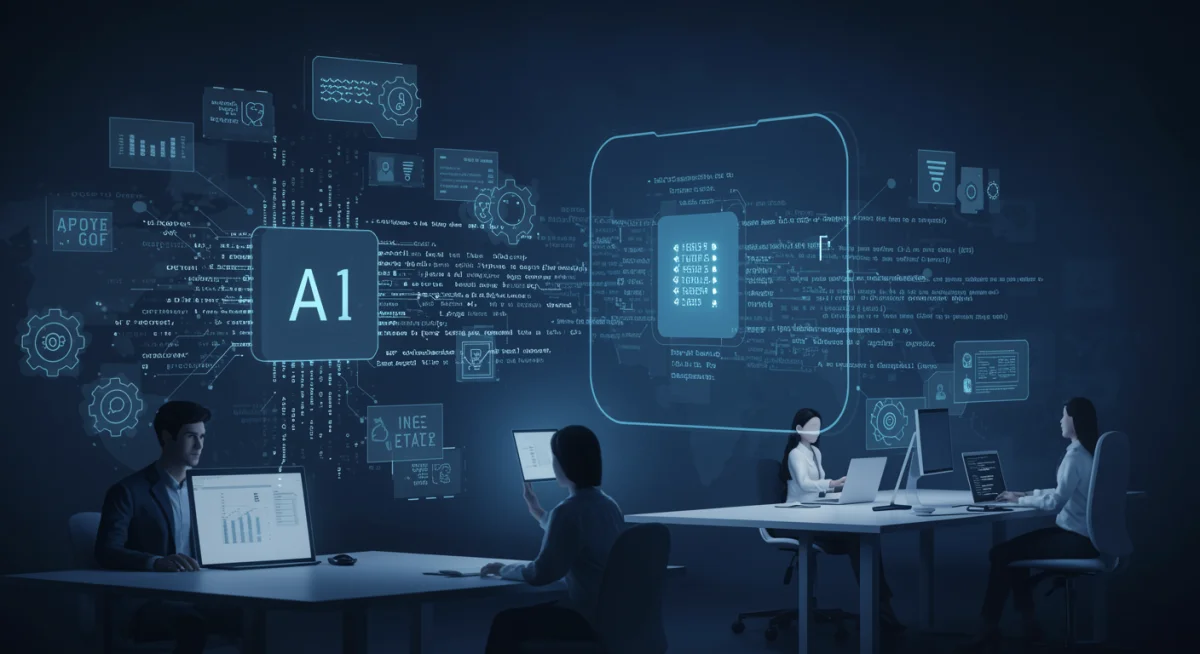
These AI-powered tools can analyze application logic and user behavior to generate comprehensive test scenarios that might be overlooked by human testers. This ensures broader test coverage, leading to more robust and reliable software. For US tech teams, this means faster time-to-market for new features and a higher degree of confidence in their product releases.
Generating Realistic Test Data
One of the persistent challenges in testing is acquiring realistic and diverse test data. Generative AI can synthesize vast amounts of synthetic data that closely mimics real-world scenarios, without compromising user privacy. This allows for more thorough testing of edge cases and complex interactions.
- Creates diverse and representative test data on demand.
- Eliminates reliance on sensitive production data for testing.
- Facilitates comprehensive testing of complex systems.
- Supports scalable test environments.
The future of QA with generative AI involves continuous, intelligent testing that adapts to code changes in real-time. This continuous feedback loop will ensure that quality is built into every stage of development, rather than being an afterthought, thereby fostering a culture of excellence and reliability.
AI-Powered API and Documentation Generation
APIs are the backbone of modern software ecosystems, and clear, comprehensive documentation is essential for their effective use. However, writing and maintaining API documentation can be a laborious and often neglected task. Generative AI offers a powerful solution by automating the creation of accurate and user-friendly API documentation.
By analyzing API code, AI models can infer functionality, parameters, and expected outputs, then transform this information into well-structured documentation. This not only saves significant developer time but also ensures that documentation remains consistent and up-to-date with code changes. For US tech teams building interconnected systems, this means smoother integration processes and reduced friction for external developers.
Streamlining API Design and Specification
Generative AI can also assist in the design phase of APIs. By understanding common design patterns and best practices, AI tools can suggest optimal API structures and specifications, leading to more consistent, scalable, and secure interfaces. This proactive guidance helps prevent design flaws early in the development cycle.
- Automates the creation of OpenAPI/Swagger specifications.
- Ensures documentation aligns perfectly with the codebase.
- Reduces manual effort in maintaining complex API docs.
- Improves developer experience for API consumers.
The role of AI in documentation extends beyond APIs to internal code comments, user manuals, and technical guides. This comprehensive approach to documentation will ensure that knowledge transfer is efficient and accurate, making onboarding new team members and maintaining legacy systems significantly easier.
Intelligent UI/UX Design and Prototyping
The user interface (UI) and user experience (UX) are paramount to the success of any software product. Generative AI is beginning to revolutionize this domain by assisting in the design and prototyping phases, allowing designers to iterate faster and create more engaging and intuitive experiences. These tools can generate design mockups, suggest layout improvements, and even create interactive prototypes based on textual descriptions or user data.
For US tech teams, this means a dramatic acceleration in the design process, enabling them to test more design variations and gather user feedback more efficiently. It also democratizes design, allowing developers with less design expertise to create aesthetically pleasing and functional interfaces with AI assistance.
Personalized User Experiences
Generative AI can analyze user behavior data to suggest personalized UI/UX elements, layouts, and content. This leads to highly tailored user experiences that adapt to individual preferences, significantly enhancing user engagement and satisfaction. This capability is particularly valuable in competitive markets where user retention is key.
- Generates a wide array of design variations quickly.
- Suggests improvements based on user data and design principles.
- Accelerates the prototyping and feedback loop.
- Enables more accessible and inclusive design.
The future of UI/UX design with generative AI will involve dynamic interfaces that evolve in real-time based on user interaction and context. This adaptive design paradigm will create truly intelligent applications that feel intuitive and responsive to every user, pushing the boundaries of what is possible in digital product design.
Ethical Considerations and Future Outlook
While the benefits of generative AI in software development are undeniable, it is crucial to address the ethical considerations and potential challenges. Issues such as bias in AI-generated code, intellectual property rights, and the potential impact on developer job roles require careful consideration. US tech teams must adopt ethical AI guidelines and implement robust oversight mechanisms to ensure responsible deployment.
The future outlook for generative AI in software development is overwhelmingly positive, characterized by greater efficiency, accelerated innovation, and enhanced human-AI collaboration. As these tools become more sophisticated, they will continue to empower developers to tackle increasingly complex problems and create groundbreaking solutions. The emphasis will shift from repetitive coding to strategic thinking, creative problem-solving, and managing AI-driven workflows.
Ensuring Responsible AI Adoption
Responsible AI adoption involves not just technical solutions but also organizational policies and a commitment to ethical principles. This includes transparency in AI models, fairness in their outputs, and accountability for their impact. Training developers to work effectively with AI and understand its limitations will be crucial.
- Develop clear ethical guidelines for AI usage.
- Implement human-in-the-loop validation for AI outputs.
- Invest in continuous education for tech teams.
- Address data privacy and security concerns proactively.
Ultimately, the synergy between human creativity and AI efficiency will define the next era of software development. Generative AI is not here to replace developers but to augment their capabilities, enabling them to achieve more than ever before. The teams that embrace this shift will be at the forefront of technological innovation in 2025 and beyond.
| Key Impact Area | Brief Description |
|---|---|
| Code Generation | Automates boilerplate, accelerates project setup, and reduces manual coding effort. |
| Debugging & Error Resolution | Predictively identifies issues and suggests fixes, streamlining troubleshooting. |
| Automated Testing | Generates comprehensive test cases and realistic data, enhancing software quality. |
| Documentation & UI/UX | Automates API documentation and assists in intelligent, personalized UI/UX design. |
Frequently Asked Questions about Generative AI in Software Development
Generative AI primarily automates and enhances various stages of software development, including code generation, debugging, testing, documentation, and UI/UX design, significantly boosting efficiency and innovation for tech teams.
It improves code quality by generating consistent, standard-compliant code, identifying potential errors predictively, and suggesting robust solutions, thereby reducing bugs and enhancing maintainability across projects.
No, generative AI is expected to augment, not replace, human developers. It handles repetitive tasks, freeing developers to focus on complex problem-solving, innovative design, and strategic architectural decisions, fostering human-AI collaboration.
Ethical concerns include potential biases in AI-generated code, intellectual property issues, and the need for robust oversight to ensure fairness, transparency, and accountability in AI’s outputs and its impact on the workforce.
Generative AI will accelerate UI/UX design by generating mockups, suggesting layouts, creating interactive prototypes, and personalizing user experiences based on data, leading to more engaging and intuitive applications.
Conclusion
The transformative power of generative AI in software development is undeniable. As we approach 2025, the tools discussed herein are not just incremental improvements but fundamental shifts in how US tech teams operate. From automating the mundane to inspiring groundbreaking design, generative AI is poised to elevate the entire software development lifecycle. Embracing these advancements responsibly, with a focus on ethical implementation and continuous learning, will be crucial for any team aiming to stay competitive and innovative in the rapidly evolving technological landscape. The future of software development is collaborative, intelligent, and excitingly efficient, driven by the synergy of human ingenuity and artificial intelligence.