Cloud Security Evolution: 5 Trends for US Businesses

US businesses must prepare for significant shifts in cloud security over the next 18 months, with artificial intelligence, SASE, and zero-trust architectures leading the charge in safeguarding digital assets.
The digital frontier is constantly expanding, and with it, the complexities of safeguarding valuable data and operations. For US businesses, understanding the trajectory of cloud security is not merely an IT concern; it’s a strategic imperative. In the next 18 months, the landscape will undergo profound changes, driven by new technologies and evolving threat vectors. This article will delve into the cloud security trends that are poised to redefine how organizations protect their digital infrastructure, ensuring resilience and compliance in an increasingly interconnected world.
The Rise of AI and Machine Learning in Cloud Security
Artificial Intelligence (AI) and ML are rapidly transforming every facet of technology, and cloud security is no exception. These advanced capabilities are moving beyond simple anomaly detection, becoming integral to predictive threat intelligence and automated response systems. For US businesses, leveraging AI/ML in their cloud security strategy will be paramount to staying ahead of sophisticated cyber threats.
The sheer volume of data generated within cloud environments makes manual analysis virtually impossible. AI algorithms can process and interpret this data at speeds and scales unattainable by human analysts, identifying subtle patterns that indicate malicious activity. This shift from reactive to proactive security is a game-changer for protecting sensitive information.
Predictive Threat Intelligence
AI-driven platforms are now capable of analyzing vast datasets from global threat intelligence feeds, historical incident data, and network traffic to predict potential attacks. This predictive capability allows security teams to harden their defenses against emerging threats before they can even materialize.
- Early Warning Systems: AI can flag unusual access patterns or data exfiltration attempts before they escalate into full-blown breaches.
- Vulnerability Prioritization: Machine learning helps identify and prioritize vulnerabilities based on their potential impact and exploitability, ensuring resources are allocated effectively.
- Automated Patching Recommendations: AI can suggest and even automate the deployment of patches for identified weaknesses, reducing the attack surface.
Automated Incident Response
Beyond detection, AI and ML are enabling more rapid and effective incident response. Automated systems can isolate compromised assets, revoke access, and even initiate remediation steps without human intervention, significantly reducing the dwell time of attackers and minimizing damage.
The integration of AI into cloud security will necessitate a new skill set for security professionals, focusing on managing and optimizing these intelligent systems rather than purely manual analysis. This trend underscores the importance of continuous learning and adaptation within cybersecurity teams. Ultimately, AI and ML will become the bedrock of resilient cloud security postures for businesses in the US, allowing them to defend against an ever-evolving threat landscape with unprecedented efficiency.
Embracing Secure Access Service Edge (SASE) Architectures
As workforces become increasingly distributed and applications migrate to the cloud, traditional perimeter-based security models are proving inadequate. Secure Access Service Edge (SASE), pronounced ‘sassy’, emerges as a transformative architectural approach that converges networking and security functions into a single, cloud-native service. For US organizations, SASE represents a strategic move towards a more flexible, scalable, and secure operational model.
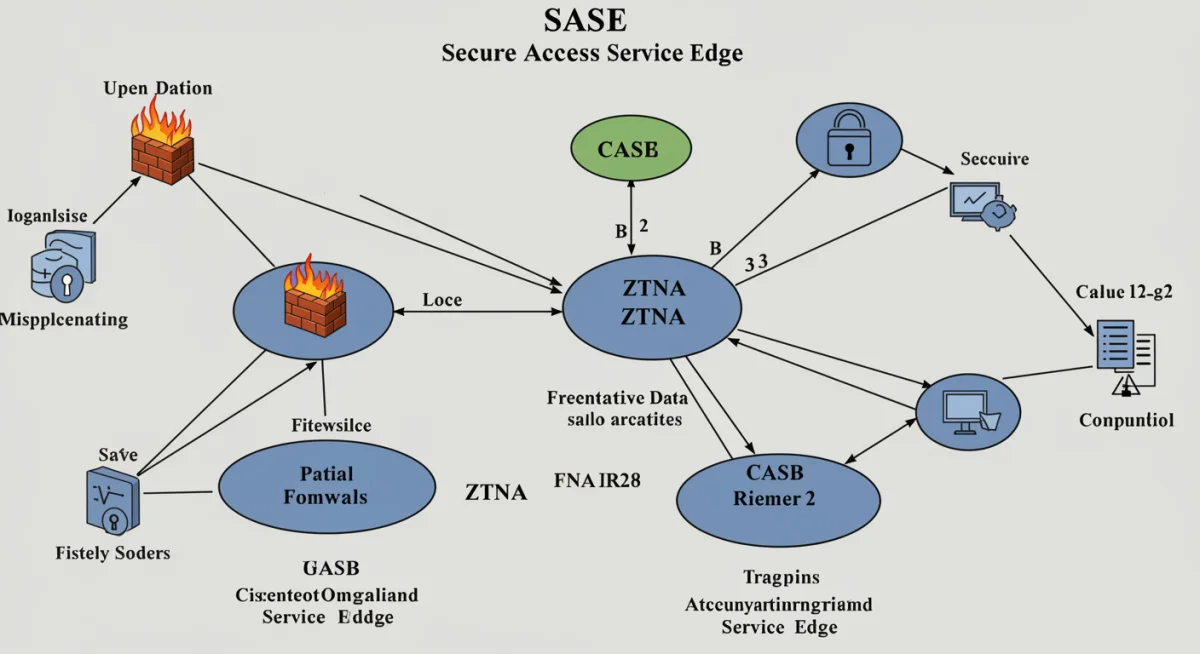
SASE integrates various security capabilities, such as Secure Web Gateway (SWG), Cloud Access Security Broker (CASB), Firewall-as-a-Service (FWaaS), and Zero Trust Network Access (ZTNA), with wide area network (WAN) capabilities. This consolidation simplifies management, enhances performance, and provides consistent security policies regardless of user location or device.
Key Components of SASE
Understanding the core elements of SASE is crucial for successful implementation. Each component plays a vital role in creating a unified security framework that protects users, applications, and data wherever they reside.
- Secure Web Gateway (SWG): Filters unwanted content from web traffic, preventing malware and ensuring compliance with acceptable use policies.
- Cloud Access Security Broker (CASB): Enforces security policies for cloud applications, offering visibility and control over data in the cloud.
- Firewall-as-a-Service (FWaaS): Delivers firewall capabilities from the cloud, protecting distributed environments without the need for on-premise hardware.
- Zero Trust Network Access (ZTNA): Provides secure remote access to applications based on explicit verification, rather than implicit trust.
Benefits for US Businesses
The adoption of SASE offers several compelling advantages for US businesses grappling with modern cybersecurity challenges. These benefits extend beyond security to include operational efficiency and user experience.
By streamlining security operations and providing a unified policy enforcement point, SASE reduces complexity and the potential for misconfigurations. It also improves network performance by routing traffic through optimized cloud infrastructure rather than backhauling it to a central data center. This integrated approach not only enhances security posture but also supports the agility required by hybrid work models and multi-cloud environments. Consequently, SASE will become a foundational element of cloud security for many forward-thinking US enterprises in the coming months.
The Imperative of Zero-Trust Security Models
The principle of “never trust, always verify” forms the bedrock of zero-trust security, a model that is rapidly transitioning from a theoretical ideal to a practical necessity for US businesses. In an era where traditional network perimeters have dissolved, assuming every user, device, and application is potentially compromised forces organizations to adopt a more stringent security posture. This trend emphasizes explicit verification at every access point, regardless of whether the entity is inside or outside the network.
Zero-trust operates on the premise that no user or device should be automatically granted access to resources. Instead, access is granted only after strict authentication and authorization, based on identity, device posture, and other contextual factors. This granular control significantly reduces the attack surface and limits lateral movement for attackers who manage to breach initial defenses.
Implementing Zero Trust Principles
Transitioning to a zero-trust model involves a fundamental shift in security philosophy and requires careful planning and execution. It’s not a single technology but rather a strategy that encompasses multiple security controls and practices.
- Identity Verification: Strong multi-factor authentication (MFA) for all users and devices is non-negotiable.
- Least Privilege Access: Users and applications are granted only the minimum access necessary to perform their tasks.
- Micro-segmentation: Network segments are broken down into smaller, isolated zones, limiting the blast radius of a breach.
- Continuous Monitoring: All network traffic and access attempts are continuously monitored for anomalous behavior.
Challenges and Opportunities
While the benefits of zero trust are clear, implementing it can present challenges, particularly for organizations with complex legacy systems. The initial investment in technology and rearchitecting existing infrastructure can be substantial. However, the long-term gains in security resilience and reduced risk far outweigh these challenges.
For US businesses, embracing zero trust offers an opportunity to build a more robust and adaptable security framework capable of defending against advanced persistent threats and insider risks. It’s a proactive approach that recognizes the limitations of traditional security and positions organizations for sustained protection in dynamic cloud environments. Over the next 18 months, zero trust will move from a recommended best practice to a fundamental requirement for secure cloud operations.
Enhanced Data Sovereignty and Compliance Controls
In an increasingly regulated world, data sovereignty and stringent compliance controls are becoming critical considerations for US businesses operating in the cloud. As data crosses geographical boundaries and resides in various cloud regions, understanding and adhering to diverse national and international data protection laws is paramount. This trend is driven by heightened privacy concerns, geopolitical factors, and the proliferation of data localization requirements.
For US organizations, navigating this complex regulatory landscape means implementing robust controls that ensure data is stored, processed, and accessed in accordance with applicable laws, such as GDPR, CCPA, and emerging state-specific regulations. Non-compliance can lead to severe penalties, reputational damage, and loss of customer trust.
Key Aspects of Data Sovereignty
Data sovereignty refers to the idea that information is subject to the laws of the country in which it is stored. This has significant implications for cloud deployments, especially for businesses with global operations or those handling data from international customers.
- Geographic Data Storage: Ensuring data resides in specific geographic locations to meet legal requirements.
- Access Control and Jurisdiction: Understanding which national laws govern access to data, even if stored by a foreign cloud provider.
- Cross-Border Data Transfers: Implementing mechanisms and agreements to legally transfer data between different jurisdictions.
Strengthening Compliance Frameworks
Beyond geographical considerations, businesses must strengthen their internal compliance frameworks to align with evolving data protection standards. This involves a multi-faceted approach that integrates legal, technical, and operational measures.
Cloud providers are continually enhancing their offerings to support these requirements, providing tools for data encryption, access logging, and regional data residency. However, the ultimate responsibility lies with the business to configure these services correctly and maintain an auditable trail of compliance. Over the next 18 months, US businesses will invest heavily in compliance automation tools and expert guidance to ensure their cloud environments meet the strictest data sovereignty and regulatory mandates, building trust with customers and avoiding legal pitfalls.
Cloud-Native Security and DevSecOps Integration
The rapid adoption of cloud-native development practices, characterized by microservices, containers, and serverless functions, necessitates a fundamentally different approach to security. Traditional security tools and methodologies often struggle to keep pace with the agility and ephemeral nature of cloud-native environments. This trend emphasizes integrating security directly into the development lifecycle, a concept known as DevSecOps, ensuring security is ‘built-in’ rather than ‘bolted-on’.
For US businesses leveraging cloud-native technologies, shifting security left – embedding it earlier in the development process – is crucial. This proactive stance helps identify and remediate vulnerabilities before they reach production, significantly reducing costs and risks associated with late-stage security fixes. Cloud-native security tools are designed to protect these dynamic components, offering granular visibility and automated enforcement.
Principles of Cloud-Native Security
Cloud-native security is not a single product but a set of principles and practices tailored for modern cloud architectures. It focuses on automation, continuous monitoring, and immutable infrastructure to maintain a strong security posture.
- Container Security: Protecting container images, registries, and runtime environments from vulnerabilities and threats.
- Serverless Security: Securing serverless functions by managing permissions, scrutinizing code, and monitoring execution.
- API Security: Implementing robust authentication, authorization, and rate limiting for APIs that connect microservices.
- Infrastructure as Code (IaC) Security: Scanning IaC templates for misconfigurations and security flaws before deployment.
DevSecOps: Bridging Development and Security
The integration of security into DevOps pipelines transforms the traditional development cycle, making security a shared responsibility across development, operations, and security teams. This collaborative approach fosters a culture of security awareness and continuous improvement.
Automated security testing, code analysis, and compliance checks are integrated into CI/CD pipelines, providing immediate feedback to developers. This prevents security issues from becoming technical debt and ensures that applications are secure by design. For US businesses, adopting DevSecOps is not just about enhancing security; it’s about accelerating innovation securely, allowing them to deploy new features and services with confidence. Over the next 18 months, the synergy between cloud-native development and integrated security practices will become a defining characteristic of resilient and agile organizations.
| Key Cloud Security Trend | Brief Description for US Businesses |
|---|---|
| AI/ML Integration | Leveraging AI for predictive threat intelligence and automated incident response to combat advanced cyber threats. |
| SASE Architectures | Converging network and security functions into a single cloud-native service for distributed workforces. |
| Zero-Trust Models | Implementing “never trust, always verify” for all access, reducing attack surface and limiting lateral movement. |
| Data Sovereignty & Compliance | Adhering to evolving data protection laws and localization requirements for global operations. |
Frequently Asked Questions About Cloud Security Trends
AI is crucial because it enables predictive threat intelligence and automated responses, handling vast data volumes that humans cannot. This allows US businesses to detect and mitigate sophisticated cyber threats more efficiently and proactively, reducing reaction time and potential damage from attacks.
SASE (Secure Access Service Edge) converges networking and security into a single cloud service. It benefits distributed US workforces by providing consistent, secure access to applications and data from any location or device, simplifying management and enhancing overall security posture for remote and hybrid models.
Zero-trust means “never trust, always verify.” For a US business, it implies that no user or device is inherently trusted, requiring explicit authentication and authorization for every access request. This model significantly reduces the attack surface and prevents unauthorized lateral movement within cloud environments.
Data sovereignty dictates that data is subject to the laws of its storage location, impacting where US businesses can host data. Compliance with regulations like GDPR and CCPA requires robust controls over data storage, processing, and access, influencing cloud provider choices and configuration strategies to avoid legal and financial penalties.
DevSecOps integrates security practices throughout the entire software development lifecycle, from design to deployment. It’s crucial for cloud-native applications because it embeds security early on, addressing vulnerabilities proactively in dynamic environments like microservices and containers, leading to more secure and resilient applications.
Conclusion
The evolving landscape of cloud security presents both challenges and opportunities for US businesses. The trends discussed – from the integration of AI and ML to the adoption of SASE architectures, the imperative of zero-trust models, enhanced data sovereignty and compliance controls, and the shift towards cloud-native security with DevSecOps – underscore a fundamental transformation in how organizations must approach digital protection. Proactive engagement with these trends, coupled with continuous adaptation and investment in robust security frameworks, will be critical for maintaining resilience, fostering trust, and ensuring sustained growth in the dynamic digital economy of the next 18 months and beyond.