AI Ethics Frameworks: US Businesses Compliance by 2025

US businesses must proactively integrate robust AI ethics frameworks by 2025 to ensure compliance, mitigate risks, and build public trust in their artificial intelligence deployments.
The rapid advancement of artificial intelligence (AI) presents unprecedented opportunities for innovation and growth, but also introduces complex ethical dilemmas. For US businesses, navigating this landscape isn’t just about technological prowess; it’s about responsible deployment. This article explores 5 AI ethics frameworks US businesses must implement by 2025 for compliance, offering a guide to proactively address the challenges and seize the promise of AI ethically.
The imperative for AI ethics in US businesses
As AI systems become more sophisticated and integrated into critical business operations, from hiring to loan applications and even medical diagnostics, their potential impact on individuals and society grows exponentially. Businesses in the United States are increasingly recognizing that ethical considerations are not merely an afterthought but a fundamental component of successful and sustainable AI adoption. The absence of clear ethical guidelines can lead to biased outcomes, privacy breaches, and significant reputational damage, alongside potential legal repercussions.
The urgency to adopt robust AI ethics frameworks stems from various factors, including evolving consumer expectations, increasing regulatory scrutiny, and the inherent risks associated with AI. Consumers are more aware than ever of how their data is used and how AI impacts their lives, demanding transparency and fairness. Regulators, both at federal and state levels, are beginning to formulate policies to govern AI, making proactive compliance a strategic advantage rather than a burden.
Understanding the evolving regulatory landscape
The US regulatory environment for AI is still taking shape, but key indicators suggest a push towards greater accountability and ethical oversight. Agencies like the National Institute of Standards and Technology (NIST) have already released foundational guidance, and various legislative proposals are under consideration. Businesses that align their AI practices with emerging ethical standards will be better positioned to adapt to future mandates and avoid costly retrofits.
- Consumer Trust: Ethical AI builds confidence and loyalty among customers.
- Risk Mitigation: Reduces the likelihood of legal challenges, fines, and public backlash.
- Competitive Advantage: Differentiates businesses as responsible innovators.
- Talent Attraction: Ethical companies attract and retain top AI professionals.
By prioritizing AI ethics, businesses can safeguard their long-term viability and foster an environment where AI serves humanity responsibly. This proactive approach ensures that innovation is balanced with societal well-being, paving the way for a more equitable and trustworthy AI future.
Framework 1: NIST AI Risk Management Framework
The National Institute of Standards and Technology (NIST) has emerged as a crucial player in shaping AI ethics in the US, particularly with its AI Risk Management Framework (AI RMF). This framework provides a structured, voluntary approach for organizations to manage the risks associated with designing, developing, deploying, and using AI systems. It’s designed to be flexible and adaptable, catering to a wide range of industries and applications.
Implementing the NIST AI RMF involves a continuous process of identifying, assessing, and mitigating AI-related risks. It emphasizes transparency, accountability, and explainability, encouraging organizations to understand and communicate how their AI systems operate and make decisions. This framework is not just a technical guide; it’s a strategic tool for integrating ethical considerations into every stage of the AI lifecycle.
Key components of the NIST AI RMF
The NIST AI RMF is built around four core functions: Govern, Map, Measure, and Manage. These functions work in concert to create a comprehensive risk management strategy for AI systems. Each function includes specific categories and subcategories that guide organizations in implementing the framework effectively.
- Govern: Establishes policies, procedures, and structures for responsible AI.
- Map: Identifies and characterizes AI risks, considering context and impact.
- Measure: Assesses, analyzes, and tracks AI risks and their mitigation.
- Manage: Prioritizes, responds to, and monitors AI risks over time.
For US businesses, adopting the NIST AI RMF by 2025 is a critical step towards demonstrating a commitment to responsible AI. It provides a common language and a systematic approach to addressing the complex ethical challenges posed by AI, ensuring that organizations can innovate confidently while minimizing harm and maximizing societal benefit.
Framework 2: OECD AI Principles
The Organisation for Economic Co-operation and Development (OECD) has developed widely recognized AI Principles that serve as a foundational guide for governments and stakeholders worldwide, including the United States. These principles aim to foster AI innovation while ensuring that AI systems are designed and used in a manner that is trustworthy and respects human rights and democratic values. They represent a global consensus on responsible AI development.
The OECD AI Principles cover a broad spectrum of ethical considerations, emphasizing inclusive growth, sustainable development, human-centered values, transparency, robustness, and accountability. While not legally binding, they provide a powerful ethical compass for businesses to align their AI strategies with international best practices. Adhering to these principles helps US businesses build trust with international partners and customers, especially in an increasingly interconnected global economy.
Integrating OECD AI Principles into business operations
For US businesses, integrating the OECD AI Principles means embedding them into corporate governance, product development, and operational policies. This involves a commitment to designing AI systems that are fair, transparent, and explainable, and ensuring that human oversight remains central to decision-making processes. It also necessitates a focus on data privacy and security, as well as robust mechanisms for redress when AI systems cause harm.
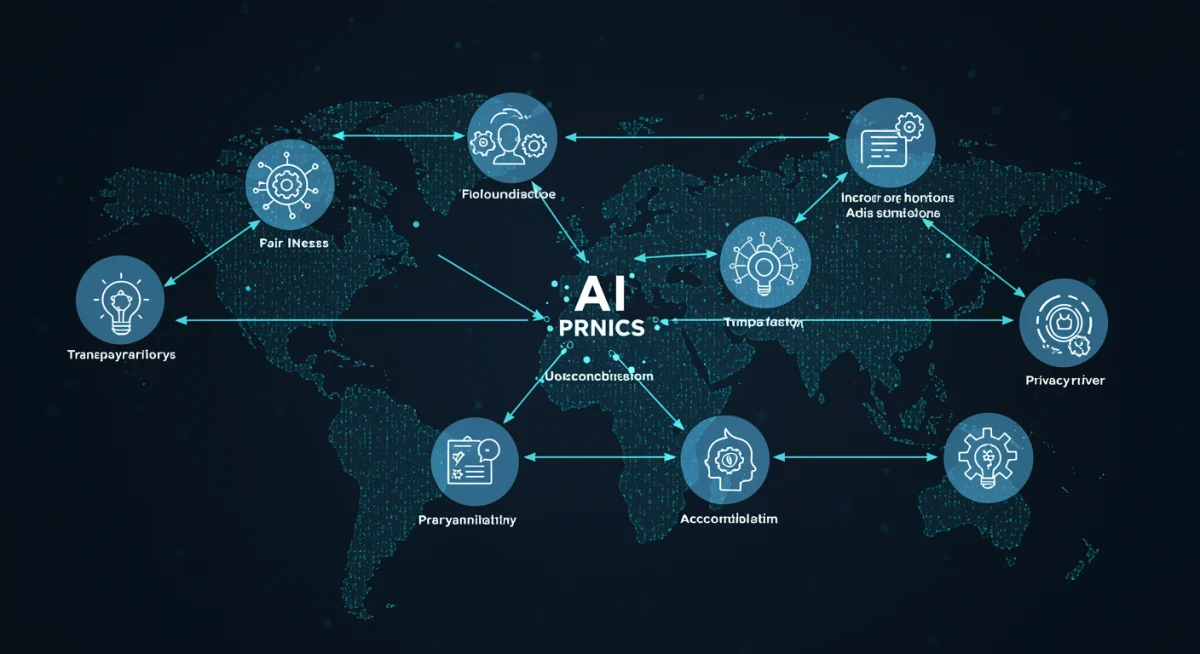
The principles encourage a multi-stakeholder approach, urging collaboration between governments, businesses, civil society, and academia to collectively address the ethical implications of AI. By embracing these principles, US businesses can not only comply with emerging standards but also contribute to a global ecosystem of responsible AI.
- Human-centered values: Prioritizing human rights, fairness, and privacy.
- Transparency and explainability: Understanding how AI systems make decisions.
- Robustness and security: Ensuring AI systems are reliable and secure.
- Accountability: Establishing clear responsibilities for AI outcomes.
Ultimately, the OECD AI Principles offer a holistic framework that guides businesses toward developing AI that benefits society while mitigating potential risks. Their adoption by 2025 will signal a strong commitment to ethical innovation.
Framework 3: European Union’s AI Act (as a global benchmark)
While the European Union’s AI Act is a regulatory framework for the EU, its influence extends far beyond its borders, making it a critical benchmark for US businesses operating globally or those seeking to align with leading international standards. The AI Act is a landmark piece of legislation that categorizes AI systems based on their risk level, imposing stringent requirements on high-risk AI applications. Understanding and anticipating its requirements is crucial for US companies.
The EU AI Act’s comprehensive nature means it addresses a wide array of ethical and safety concerns, including data quality, human oversight, transparency, cybersecurity, and fundamental rights. Even for businesses primarily focused on the US market, familiarizing themselves with these regulations can provide a robust foundation for building ethical AI systems that are resilient to future domestic regulations and competitive on a global scale.
Preparing for the global impact of the EU AI Act
US businesses should view the EU AI Act not as a distant European problem, but as an indicator of the direction global AI regulation is heading. Proactive compliance with elements of the Act can position companies as leaders in responsible AI, enhancing their reputation and marketability. This involves adopting similar risk assessment methodologies, ensuring high-quality and unbiased datasets, and implementing robust governance structures.
Furthermore, businesses that develop AI systems for deployment in the EU will be directly subject to the Act’s provisions. This necessitates a thorough understanding of its requirements for conformity assessments, post-market monitoring, and the establishment of regulatory sandboxes. Even those not directly impacted should consider its principles as a blueprint for best practices.
The EU AI Act underscores the increasing global demand for ethical and safe AI. By incorporating its spirit into their own frameworks, US businesses can future-proof their AI strategies and demonstrate a commitment to global ethical leadership.
Framework 4: IEEE Global Initiative for Ethical AI and Autonomous Systems
The Institute of Electrical and Electronics Engineers (IEEE) has spearheaded a comprehensive global initiative focused on putting ethics into the design of autonomous and intelligent systems. This initiative has produced a series of ethical guidelines and standards, most notably “Ethically Aligned Design: A Vision for Priorizing Human Well-being with Autonomous and Intelligent Systems.” These guidelines are developed through a collaborative, multi-stakeholder process, involving experts from technology, law, ethics, and policy.
The IEEE’s work provides practical, actionable recommendations for engineers, designers, and policymakers to ensure that AI systems are developed with human well-being at their core. It goes beyond abstract principles, offering concrete advice on how to embed ethical considerations into the technical specifications and development processes of AI technologies. For US businesses, adopting these guidelines means a deeper integration of ethics at the very design stage.
Practical application of IEEE ethical guidelines
Implementing the IEEE’s framework involves a shift in mindset, encouraging developers to consider the societal impact of their AI designs from conception. This includes focusing on transparency, accountability, and the avoidance of bias. The guidelines advocate for a “values-based” design approach, where human values are explicitly considered and prioritized throughout the AI lifecycle.
- Transparency: Designing systems whose operations are understandable.
- Accountability: Assigning clear responsibility for AI system decisions.
- Algorithmic Bias: Actively working to identify and mitigate biases in data and algorithms.
- Human Autonomy: Ensuring AI complements, rather than diminishes, human decision-making.
By 2025, US businesses should be actively incorporating these granular, engineering-focused ethical guidelines into their AI development pipelines. This not only helps in building more responsible AI but also fosters a culture of ethical innovation within the organization, leading to more trustworthy and impactful AI solutions.
Framework 5: Partnership on AI (PAI) Responsible AI Guidelines
The Partnership on AI (PAI) is a non-profit organization comprised of leading companies, academics, and civil society organizations working to ensure that AI benefits humanity. PAI’s responsible AI guidelines and best practices are developed through collaborative research and public dialogue, offering practical insights into how organizations can develop and deploy AI responsibly. Their strength lies in their industry-driven, consensus-based approach.
PAI’s work covers a wide range of topics, including fairness, transparency, safety, and the societal impact of AI. Their guidelines are particularly valuable for US businesses because they often reflect the collective wisdom of major tech companies and experts, providing a pragmatic pathway for integrating ethical considerations into real-world AI applications. Adopting these guidelines helps businesses align with industry leaders and evolving best practices.
Leveraging PAI for practical ethical AI implementation
For US businesses, leveraging PAI’s guidelines means engaging with their research, participating in their working groups, and applying their recommendations to internal AI development. This could involve adopting PAI’s principles for developing explainable AI, implementing strategies for reducing algorithmic bias, or establishing clear human oversight mechanisms for automated systems. Their resources often provide concrete examples and methodologies for addressing complex ethical challenges.
PAI’s emphasis on collaboration and shared learning makes it an invaluable resource for businesses seeking to build a robust ethical AI program. By 2025, actively engaging with and implementing PAI’s responsible AI guidelines will demonstrate a commitment to advancing AI that is both innovative and ethically sound, fostering a greater degree of public trust and regulatory acceptance.
Embracing the PAI framework allows businesses to stay ahead of the curve, drawing on collective industry expertise to navigate the complex ethical landscape of AI effectively and responsibly.
Integrating AI ethics into corporate culture and governance
Beyond adopting specific frameworks, the true success of ethical AI implementation hinges on integrating these principles into the very fabric of a business’s corporate culture and governance. This is not a one-time compliance exercise but an ongoing commitment that requires leadership buy-in, employee training, and continuous evaluation. Establishing a strong ethical foundation ensures that AI development and deployment are consistently guided by responsible practices.
This integration involves creating internal AI ethics committees, appointing chief AI ethics officers, or embedding ethical considerations into existing corporate social responsibility (CSR) initiatives. It also means fostering a culture where employees at all levels, from data scientists to product managers, understand their role in upholding ethical AI standards and are empowered to raise concerns without fear of reprisal.
Building an ethical AI ecosystem within your organization
An ethical AI ecosystem thrives on clear policies, transparent processes, and regular audits. Businesses should develop internal guidelines that translate external frameworks into actionable steps relevant to their specific operations and industry. This includes defining acceptable use policies for AI, establishing protocols for data collection and usage, and implementing robust mechanisms for identifying and mitigating bias.
- Leadership Commitment: Top-down endorsement of ethical AI principles.
- Employee Training: Educating staff on AI ethics and responsible practices.
- Internal Audits: Regularly assessing AI systems for ethical compliance and performance.
- Stakeholder Engagement: Involving diverse voices in ethical AI discussions.
By 2025, US businesses must move beyond superficial declarations to embed AI ethics deeply within their operational DNA. This proactive approach not only ensures compliance with evolving regulations but also positions them as trusted leaders in the AI era, capable of harnessing its power for positive societal impact while safeguarding against its potential pitfalls.
| Framework | Key Focus |
|---|---|
| NIST AI RMF | Voluntary risk management for AI lifecycle. |
| OECD AI Principles | Global ethical guidance for human-centered AI. |
| EU AI Act | Risk-based regulatory benchmark for AI. |
| IEEE Global Initiative | Engineering-focused ethical design principles. |
Frequently asked questions about AI ethics frameworks
AI ethics frameworks are crucial because they ensure compliance with emerging regulations, mitigate financial and reputational risks, build consumer trust, and foster responsible innovation. Proactive implementation prepares businesses for the evolving regulatory landscape and positions them as ethical leaders in the AI domain.
The NIST AI RMF provides a flexible, voluntary structure for identifying, assessing, and managing AI-related risks throughout the entire AI lifecycle. It emphasizes transparency, accountability, and explainability, helping organizations systematically address ethical challenges and build trustworthy AI systems.
Yes, while directly applicable in the EU, the EU AI Act sets a global benchmark for AI regulation. US businesses benefit from understanding its stringent requirements for high-risk AI, as it indicates future regulatory trends and can guide best practices for responsible AI development worldwide.
Corporate culture is foundational. Effective AI ethics implementation requires leadership buy-in, employee training, and a culture that empowers staff to prioritize ethical considerations. Embedding ethics into daily operations ensures consistent adherence and fosters a responsible AI development environment.
Measuring effectiveness involves regular internal audits, impact assessments for new AI deployments, stakeholder feedback mechanisms, and adherence to established KPIs for fairness, transparency, and accountability. Continuous monitoring and adaptation are key to ensuring frameworks remain relevant and robust.
Conclusion
The journey towards responsible AI is an ongoing one, and for US businesses, 2025 marks a crucial deadline for solidifying their commitment to ethical practices. By proactively adopting and integrating the 5 AI ethics frameworks US businesses must implement by 2025 for compliance – including NIST AI RMF, OECD AI Principles, insights from the EU AI Act, IEEE Global Initiative, and PAI guidelines – companies can navigate the complexities of AI with integrity. This strategic approach not only ensures regulatory compliance and mitigates risks but also fosters innovation, builds trust with consumers and partners, and ultimately contributes to a more equitable and beneficial AI-driven future. The time to act is now, transforming ethical considerations from abstract ideals into actionable business imperatives.