Next-Gen 5G Applications: 4 Innovations for U.S. Business Edge

U.S. businesses can gain a significant 20% market edge by strategically adopting next-gen 5G applications, leveraging advanced capabilities in areas like enhanced mobile broadband, ultra-reliable low-latency communications, and massive machine-type communications for transformative operational efficiency and new service creation.
The rapid evolution of wireless technology is ushering in an era where next-gen 5G applications are no longer a distant dream but a tangible reality for U.S. businesses. This transformative shift promises not just faster internet, but a fundamental rethinking of how industries operate, innovate, and compete on a global scale.
Understanding the Core of Next-Gen 5G Capabilities
Next-generation 5G transcends its predecessors by offering three foundational pillars: enhanced Mobile Broadband (eMBB), Ultra-Reliable Low-Latency Communications (URLLC), and Massive Machine-Type Communications (mMTC). These pillars collectively unlock unprecedented potential for U.S. enterprises, enabling new business models and operational efficiencies that were previously unattainable.
The distinction between traditional 4G LTE and 5G is not merely about speed. While 5G offers significantly faster data rates, its true power lies in its capacity for ultra-low latency and the ability to connect a vast number of devices simultaneously. This creates a fertile ground for innovations across various sectors, from manufacturing to healthcare.
Enhanced Mobile Broadband (eMBB) for Data-Intensive Operations
eMBB provides substantially higher bandwidth and faster speeds, making it ideal for applications requiring rapid data transfer and rich media experiences. For businesses, this translates into:
- Seamless cloud access and real-time collaboration tools.
- High-definition video streaming for remote inspections and training.
- Faster download and upload times for large datasets, boosting productivity.
The implications of eMBB extend to customer engagement and internal operations, allowing for more dynamic digital interactions and efficient data handling.
Ultra-Reliable Low-Latency Communications (URLLC) for Critical Systems
URLLC is perhaps the most revolutionary aspect of 5G, offering latencies as low as 1 millisecond and extremely high reliability. This capability is crucial for mission-critical applications where even a momentary delay can have severe consequences.
Industries such as autonomous vehicles, remote surgery, and industrial automation are poised to benefit immensely from URLLC. The precise and immediate feedback loops enabled by URLLC will foster new levels of safety, control, and efficiency in these demanding environments.
Massive Machine-Type Communications (mMTC) for IoT Scale
mMTC supports the connection of millions of devices per square kilometer, a vital feature for the burgeoning Internet of Things (IoT). This capability allows businesses to deploy vast networks of sensors and smart devices to collect data from their operations, infrastructure, and products.
From smart city initiatives to precision agriculture and connected logistics, mMTC enables comprehensive data collection and analysis, driving informed decision-making and predictive maintenance. This massive connectivity forms the backbone of truly intelligent systems.
In essence, next-gen 5G capabilities are not just an upgrade but a paradigm shift that redefines the technological landscape for U.S. businesses. By understanding and strategically implementing these core features, companies can unlock significant competitive advantages and drive innovation.
Innovation 1: Transforming Manufacturing with 5G-Powered IoT and AI
The manufacturing sector stands at the precipice of a revolution, driven by the convergence of 5G, the Internet of Things (IoT), and Artificial Intelligence (AI). This powerful trio is enabling U.S. businesses to move beyond traditional automation towards truly smart factories, characterized by unparalleled efficiency, flexibility, and predictive capabilities.
5G’s ultra-reliable low-latency communication (URLLC) and massive machine-type communication (mMTC) capabilities are foundational to this transformation. They allow for the seamless integration of countless sensors, robots, and machines, creating a highly interconnected and intelligent production environment. This level of connectivity provides real-time data streams that are essential for AI-driven insights.
Smart Factories and Predictive Maintenance
Within a 5G-enabled smart factory, IoT sensors collect vast amounts of data from machinery, monitoring parameters such as temperature, vibration, and performance. This data is then fed into AI algorithms that can analyze patterns and predict potential equipment failures before they occur.
- Reduced Downtime: Predictive maintenance minimizes unexpected breakdowns, significantly reducing costly production stoppages.
- Optimized Performance: AI can fine-tune machine operations for maximum efficiency and output.
- Enhanced Safety: Early detection of anomalies can prevent hazardous situations, improving worker safety.
This proactive approach to maintenance not only saves money but also ensures a smoother, more reliable manufacturing process.
Real-Time Quality Control and Supply Chain Optimization
5G’s low latency allows for real-time quality control systems. High-resolution cameras and sensors can instantly detect defects on production lines, triggering immediate adjustments or flagging items for removal. This ensures consistent product quality and reduces waste.
Furthermore, 5G-powered IoT extends to supply chain management. Sensors on inventory, vehicles, and even individual products provide real-time tracking and condition monitoring. AI can then analyze this data to optimize logistics, predict demand fluctuations, and manage inventory levels more effectively. This end-to-end visibility and control lead to a highly resilient and responsive supply chain.
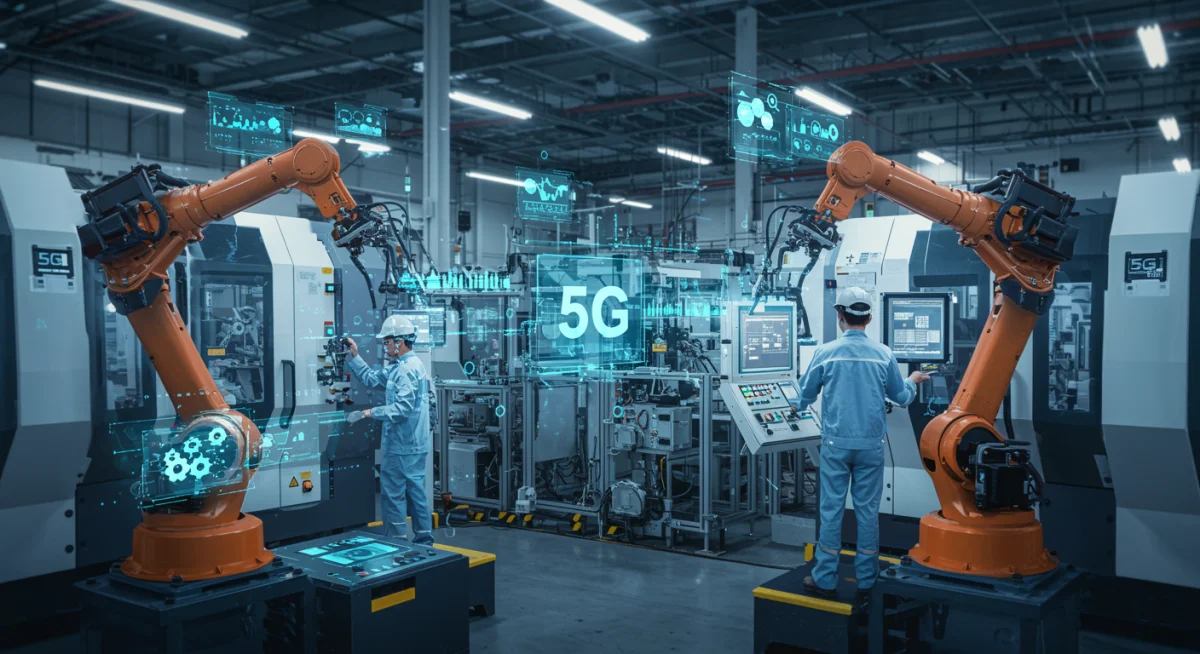
The integration of 5G, IoT, and AI is not just about incremental improvements; it’s about fundamentally redefining manufacturing processes. U.S. businesses that embrace these technologies can achieve significant gains in productivity, cost reduction, and market responsiveness, securing a substantial competitive edge.
Innovation 2: Edge Computing and Distributed Intelligence
The synergy between 5G and edge computing represents another pivotal innovation for U.S. businesses. While 5G provides the high-speed, low-latency network, edge computing brings computational power closer to the data source. This powerful combination minimizes reliance on centralized cloud infrastructure for certain tasks, leading to faster processing, enhanced security, and more resilient applications.
Distributed intelligence, facilitated by edge computing, means that data can be processed and analyzed at the network’s edge, often directly on devices or local servers. This is particularly crucial for applications that require immediate decision-making, where even a few milliseconds of delay can be critical. The implications for industries are profound, enabling truly responsive and autonomous systems.
Benefits of Edge Computing with 5G
The adoption of edge computing alongside 5G offers several compelling advantages for businesses:
- Reduced Latency: Processing data closer to the source eliminates the round-trip delay to a central cloud, crucial for real-time applications.
- Enhanced Security: Localized data processing can reduce the attack surface and keep sensitive data within a controlled perimeter.
- Bandwidth Optimization: Only processed insights, rather than raw data, need to be sent to the cloud, conserving network resources.
- Improved Reliability: Edge systems can operate effectively even when connectivity to the central cloud is intermittent or unavailable.
These benefits are particularly impactful for scenarios involving mission-critical operations or vast numbers of connected devices.
Applications in Smart Cities and Autonomous Systems
Consider smart city initiatives, where countless sensors monitor traffic, air quality, and public safety. With 5G and edge computing, traffic signals can adjust in real-time based on local conditions, or emergency services can be dispatched more rapidly by processing incident data at the edge. This local intelligence makes cities more efficient and responsive.
Autonomous vehicles are another prime example. Self-driving cars require instantaneous decision-making based on sensor data. Relying solely on cloud processing would introduce unacceptable delays. Edge computing allows these vehicles to process critical environmental data locally, enabling immediate reactions to changing road conditions and ensuring passenger safety.
By bringing intelligence closer to the point of action, 5G and edge computing empower U.S. businesses to build more agile, secure, and performant applications, driving innovation across a spectrum of industries and delivering a significant market advantage.
Innovation 3: Immersive Experiences with AR/VR and Digital Twins
The enhanced capabilities of next-gen 5G, particularly its high bandwidth and ultra-low latency, are poised to revolutionize immersive experiences through Augmented Reality (AR), Virtual Reality (VR), and the creation of digital twins. These technologies offer U.S. businesses unprecedented opportunities for remote collaboration, advanced training, and innovative customer engagement.
Traditional networks often struggle with the massive data requirements and latency sensitivity of AR/VR applications. 5G overcomes these limitations, enabling seamless, high-fidelity immersive environments that can be accessed and utilized in real-time. This opens up entirely new paradigms for how businesses design, operate, and interact with their physical and digital assets.
Augmented Reality (AR) and Virtual Reality (VR) in Business
AR and VR are moving beyond gaming into practical business applications, thanks to 5G:
- Remote Assistance and Maintenance: Technicians can receive real-time, augmented guidance from experts located anywhere, overlaying instructions or schematics onto physical equipment.
- Immersive Training: Employees can undergo realistic simulations for complex procedures, from surgical training to operating heavy machinery, reducing risks and costs.
- Product Design and Visualization: Designers can collaborate on virtual prototypes in shared VR spaces, iterating faster and reducing the need for physical mock-ups.
These applications enhance efficiency, reduce travel, and provide richer, more effective learning and collaboration experiences.
Digital Twins for Real-Time Monitoring and Optimization
A digital twin is a virtual replica of a physical object, process, or system, updated in real-time with data from its physical counterpart. 5G facilitates the continuous, high-volume data flow required to keep these digital models accurate and responsive.
With 5G-powered digital twins, businesses can:
- Monitor Performance: Track the health and performance of assets like industrial machinery, buildings, or entire cities in a virtual environment.
- Predict Outcomes: Simulate various scenarios and predict how changes will impact the physical system, optimizing operations.
- Test Innovations: Experiment with new designs or operational strategies in the digital realm before implementing them physically, minimizing risks.
For example, a manufacturing plant could have a digital twin that precisely mirrors its physical operations, allowing managers to identify bottlenecks or test new production layouts virtually before making costly physical changes. This capability offers a powerful tool for continuous improvement and strategic planning.
The convergence of 5G with AR/VR and digital twins is enabling U.S. businesses to create more dynamic, interactive, and intelligent operational environments, fostering innovation and providing a significant competitive edge through enhanced decision-making and efficiency.
Innovation 4: Enhanced Public Safety and Smart Infrastructure
Next-gen 5G applications are not just transforming industries; they are also fundamentally altering the landscape of public safety and urban infrastructure in the U.S. By providing unparalleled connectivity, low latency, and massive device support, 5G enables a new generation of smart city services and emergency response systems that are more efficient, proactive, and ultimately, life-saving.
The ability to connect vast networks of sensors, cameras, and communication devices in real-time creates a comprehensive ecosystem for monitoring, managing, and responding to urban challenges. This integrated approach moves beyond reactive measures, allowing for predictive insights and rapid coordination across various public services.
Real-Time Emergency Response and Communication
For first responders, 5G offers a critical advantage. Ultra-reliable low-latency communications (URLLC) ensure that mission-critical data, such as live video feeds from incident sites, biometric data from affected individuals, or detailed building schematics, can be transmitted instantly and without interruption. This empowers emergency personnel with real-time situational awareness, leading to faster and more effective interventions.
- Drone Surveillance: 5G-enabled drones can provide aerial views of disaster zones, transmitting high-resolution footage to command centers in real-time.
- Connected Ambulances: Paramedics can transmit patient data and vital signs to hospitals en route, allowing medical teams to prepare for arrival.
- Push-to-Talk over Cellular (PoC): Enhanced 5G networks provide robust and secure PoC capabilities, ensuring seamless communication among emergency teams.
These capabilities significantly improve coordination and decision-making during critical events.
Smart Infrastructure for Urban Management
Beyond emergency services, 5G is the backbone for developing truly smart infrastructure. Cities can deploy a dense network of IoT sensors to monitor everything from traffic flow and parking availability to waste levels and structural integrity of bridges.
This data, processed at the edge and analyzed by AI, allows city planners to optimize resource allocation, reduce congestion, and improve environmental quality. For example, smart streetlights can adjust brightness based on real-time pedestrian and vehicle traffic, saving energy, while interconnected public transport systems can dynamically reroute based on demand.
Moreover, 5G enables advanced video analytics for public spaces, enhancing security and helping to identify potential threats or manage large crowds more effectively. This proactive management of urban environments improves the quality of life for residents and fosters sustainable growth.
By leveraging next-gen 5G applications, U.S. businesses and municipalities can create safer, more efficient, and more resilient urban environments, leading to significant societal benefits and demonstrating a powerful competitive advantage in technological adoption.
Strategic Implementation for a 20% Market Edge
Achieving a 20% market edge through next-gen 5G applications requires more than just adopting the technology; it demands a strategic, holistic approach to implementation. U.S. businesses must carefully assess their current infrastructure, identify key areas for digital transformation, and foster a culture of innovation to fully capitalize on 5G’s potential. This strategic roadmap involves several critical steps, from pilot projects to workforce development and continuous evaluation.
The journey to leveraging 5G for competitive advantage is not a one-time deployment but an ongoing process of integration and optimization. Companies that excel in this space will be those that view 5G not just as a connectivity upgrade, but as an enabler for entirely new business models and operational efficiencies.
Piloting and Phased Rollouts
Rather than attempting a widespread, immediate overhaul, businesses should consider starting with targeted pilot projects. This allows for testing 5G applications in a controlled environment, gathering valuable data, and refining strategies before scaling up. Focusing on specific use cases that offer clear, measurable benefits can demonstrate early ROI and build internal support.
- Identify High-Impact Areas: pinpoint departments or processes where 5G can deliver the most immediate and significant improvements.
- Collaborate with Providers: work closely with 5G network operators and technology vendors to ensure optimal deployment and support.
- Measure and Iterate: continuously monitor the performance of pilot projects, collect feedback, and make necessary adjustments.
A phased rollout strategy minimizes disruption, manages risk, and ensures that lessons learned from initial deployments inform subsequent phases.
Workforce Development and Digital Culture
The successful integration of 5G applications also hinges on a skilled workforce capable of operating and innovating with these new technologies. Businesses must invest in training programs to upskill existing employees and attract new talent with expertise in areas like IoT, AI, edge computing, and cybersecurity.
Equally important is fostering a digital-first culture that embraces experimentation and continuous learning. Encouraging employees to explore new ways 5G can enhance their work, and providing the tools and support to do so, will drive organic innovation from within the organization. This cultural shift is vital for sustaining a competitive edge in the long term.
Data Governance and Cybersecurity
With the proliferation of connected devices and real-time data streams enabled by 5G, robust data governance and cybersecurity frameworks become paramount. Businesses must establish clear policies for data collection, storage, processing, and usage, ensuring compliance with privacy regulations.
Implementing advanced cybersecurity measures, including encryption, access controls, and threat detection systems, is essential to protect sensitive data and critical infrastructure from cyber threats. A proactive approach to security builds trust and resilience, which are fundamental to leveraging 5G’s full potential.
By strategically approaching 5G implementation through careful planning, workforce development, and strong security, U.S. businesses can effectively harness these next-gen applications to gain a significant and sustainable market advantage.
Challenges and Considerations for U.S. Businesses
While the promise of next-gen 5G applications for U.S. businesses is immense, their successful adoption is not without challenges. Companies must navigate a complex landscape involving infrastructure investment, regulatory hurdles, cybersecurity risks, and the need for significant organizational change. Addressing these considerations proactively is crucial for realizing the full potential of 5G and achieving a sustainable competitive advantage.
Understanding and mitigating these challenges from the outset will enable businesses to build more resilient and effective 5G strategies, ensuring that their investments yield the desired market edge rather than becoming costly missteps.
Infrastructure Investment and Deployment
One of the primary challenges is the substantial investment required for 5G infrastructure. While network operators are building out public 5G networks, many enterprise-specific applications, particularly in manufacturing or logistics, may necessitate private 5G networks or specialized infrastructure to ensure dedicated bandwidth and security.
- Cost of Equipment: Deploying new 5G-compatible devices, sensors, and network equipment can be expensive.
- Spectrum Availability: Access to appropriate spectrum bands for enterprise use can be a limiting factor in some regions.
- Integration Complexity: Integrating 5G with existing legacy systems requires careful planning and execution to avoid disruptions.
Businesses must conduct thorough cost-benefit analyses and explore various deployment models, including hybrid approaches that combine public and private 5G, to find the most viable solution.
Cybersecurity and Data Privacy
The expanded attack surface created by massive IoT deployments and edge computing with 5G introduces new cybersecurity risks. Protecting vast amounts of data flowing across the network, much of it sensitive or mission-critical, becomes a paramount concern. Data privacy regulations also add another layer of complexity that businesses must address.
Companies need to implement multi-layered security strategies, including advanced encryption, intrusion detection systems, and robust identity and access management. Furthermore, adhering to data privacy frameworks like GDPR (for international operations) and various state-level regulations in the U.S. is essential to maintain customer trust and avoid legal penalties.
Regulatory Landscape and Standardization
The regulatory environment for 5G, especially concerning spectrum allocation, data sovereignty, and cross-border data flow, is still evolving. U.S. businesses operating globally or those with complex supply chains must stay abreast of these changes to ensure compliance.
Moreover, the fragmentation of standards and interoperability issues between different vendors’ 5G equipment and applications can hinder seamless integration and scalability. Businesses should prioritize solutions that adhere to open standards and have a clear roadmap for future compatibility.
By proactively addressing these challenges related to infrastructure, security, and regulation, U.S. businesses can strategically navigate the complexities of 5G adoption, ensuring a smoother transition and maximizing their potential for a competitive market edge.
| Key Innovation | Business Impact |
|---|---|
| 5G-Powered IoT & AI | Transforms manufacturing with smart factories, predictive maintenance, and real-time quality control. |
| Edge Computing | Enables distributed intelligence, reducing latency for autonomous systems and smart city applications. |
| AR/VR & Digital Twins | Creates immersive experiences for remote collaboration, advanced training, and real-time asset optimization. |
| Enhanced Public Safety | Improves emergency response with real-time data and enables smarter, more efficient urban infrastructure. |
Frequently Asked Questions About Next-Gen 5G Applications
Next-gen 5G offers U.S. businesses enhanced mobile broadband, ultra-reliable low-latency communications, and massive machine-type communications. These capabilities translate into increased operational efficiency, new revenue streams, real-time data processing, and the ability to deploy innovative services like smart factories and immersive training.
In manufacturing, 5G-powered IoT sensors provide real-time data to AI algorithms, enabling predictive maintenance to reduce downtime and optimize machine performance. It also facilitates real-time quality control and end-to-end supply chain optimization, leading to more resilient and efficient production processes.
Edge computing, when combined with 5G, brings computational power closer to the data source. This significantly reduces latency, enhances security, and optimizes bandwidth usage by processing data locally. It is critical for real-time applications such as autonomous vehicles and smart city infrastructure, where immediate decision-making is essential.
5G’s high bandwidth and low latency are crucial for seamless AR/VR experiences and the real-time operation of digital twins. These technologies enable remote assistance, immersive training simulations, and virtual product design. Digital twins, updated instantly via 5G, allow businesses to monitor, predict, and optimize physical assets and processes virtually.
Key challenges for U.S. businesses adopting 5G include significant infrastructure investment, navigating evolving regulatory landscapes, and addressing complex cybersecurity and data privacy concerns. Additionally, integrating 5G with legacy systems and developing a skilled workforce are critical for successful implementation and achieving a competitive edge.
Conclusion
The advent of next-gen 5G applications presents an unparalleled opportunity for U.S. businesses to redefine their operational paradigms and secure a significant market advantage. By strategically embracing innovations in 5G-powered IoT and AI for manufacturing, leveraging edge computing for distributed intelligence, deploying immersive AR/VR experiences and digital twins, and enhancing public safety and smart infrastructure, companies can unlock unprecedented levels of efficiency, innovation, and responsiveness. While challenges related to investment, cybersecurity, and regulation exist, a proactive and strategic approach will enable businesses to navigate these complexities, ultimately driving growth and competitiveness in an increasingly connected world.