
Next-Gen Robotics: 7 Innovations Driving Automation in US Manufacturing This Year are fundamentally reshaping industrial processes by enhancing precision, safety, and efficiency across diverse sectors.
The landscape of American industry is in constant flux, driven by relentless innovation. This year, a significant force reshaping the sector is Next-Gen Robotics: 7 Innovations Driving Automation in US Manufacturing This Year. These advancements are not just incremental improvements; they represent a paradigm shift in how goods are produced, promising a future of enhanced efficiency, safety, and unprecedented precision.
The rise of collaborative robots (cobots)
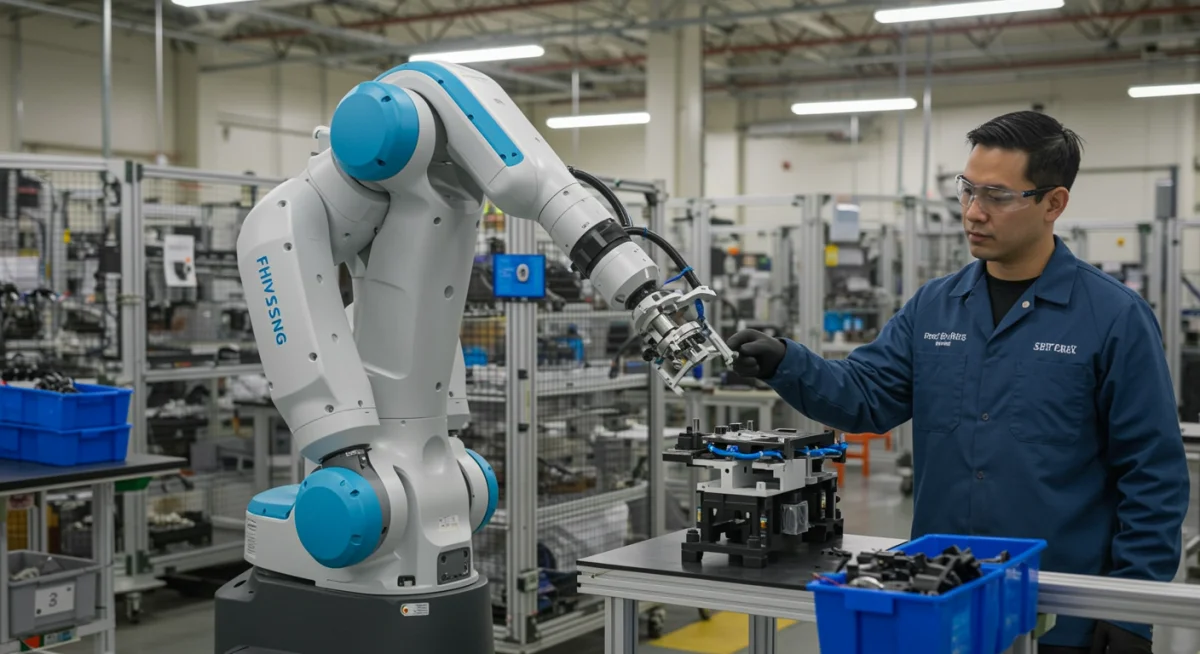
Collaborative robots, or cobots, are transforming manufacturing by enabling humans and machines to work together seamlessly. Unlike traditional industrial robots that operate in cages for safety, cobots are designed with advanced sensors and safety features that allow them to share workspaces with human employees, enhancing productivity and flexibility.
These intelligent machines are particularly valuable in tasks that require both robotic precision and human dexterity or judgment. They can handle repetitive or ergonomically challenging tasks, freeing human workers to focus on more complex, creative, or supervisory roles. This synergy leads to significant improvements in overall operational efficiency and employee satisfaction.
Enhanced human-robot interaction
The integration of cobots into manufacturing environments is redefining the human-machine interface. Their intuitive programming and adaptable nature mean that even small and medium-sized enterprises (SMEs) can deploy them without extensive robotics expertise.
- Ease of programming: Many cobots can be programmed by demonstration, allowing workers to simply guide the robot arm through the desired motion.
- Safety features: Built-in force and proximity sensors ensure that cobots stop or slow down if they detect human contact or presence.
- Adaptability: Cobots can be easily redeployed to different tasks, offering flexibility in dynamic production environments.
The proliferation of cobots signifies a move towards a more human-centric automation model. Rather than replacing workers, cobots augment their capabilities, leading to higher-quality outputs and a safer working environment. This collaborative approach fosters an environment where innovation thrives, and human potential is maximized, making US manufacturing more competitive globally.
Artificial intelligence and machine learning in robotics
The infusion of artificial intelligence (AI) and machine learning (ML) into robotics is elevating automation beyond mere programmed movements. Today’s next-gen robots are not just performing tasks; they are learning, adapting, and optimizing their operations autonomously, leading to unprecedented levels of efficiency and problem-solving capabilities on the factory floor.
AI-driven robots can analyze vast amounts of data from their environment, identify patterns, and make real-time decisions. This capability is crucial for tasks requiring high precision, dynamic adaptation, or complex quality control, where traditional robots might fall short. The ability to learn from experience allows these systems to continuously improve their performance over time.
Predictive maintenance and quality control
One of the most significant applications of AI in robotics is in predictive maintenance. Robots equipped with AI can monitor their own performance and anticipate potential failures, scheduling maintenance before breakdowns occur. This minimizes downtime and extends the lifespan of machinery.
- Real-time data analysis: AI algorithms process sensor data to detect anomalies indicating wear or malfunction.
- Optimized scheduling: Maintenance is performed precisely when needed, reducing unnecessary interventions and maximizing uptime.
- Reduced operational costs: Preventing unexpected failures significantly cuts down on repair costs and production losses.
Furthermore, AI-powered vision systems are revolutionizing quality control. These systems can inspect products with greater speed and accuracy than human eyes, identifying even minute defects and ensuring consistent product quality. This level of precision is vital for industries with stringent quality standards, such as automotive and aerospace, reinforcing the move towards flawless production.
Advanced mobile robotics (AMRs) for logistics
Advanced Mobile Robots (AMRs) are fundamentally reshaping internal logistics within US manufacturing facilities. Unlike traditional Automated Guided Vehicles (AGVs) that follow fixed paths, AMRs navigate dynamically using onboard sensors, cameras, and sophisticated mapping software. This autonomy allows them to adapt to changing environments, avoid obstacles, and optimize routes in real-time, significantly boosting efficiency and flexibility in material handling.
The deployment of AMRs eliminates the need for costly and disruptive infrastructure changes, such as embedded wires or magnetic strips. This makes them highly scalable and adaptable to various factory layouts and production needs. They can seamlessly integrate into existing workflows, transporting raw materials, work-in-progress, and finished goods, thereby reducing manual labor and improving safety.
Dynamic navigation and operational flexibility
AMRs’ ability to navigate complex, dynamic environments is a game-changer for modern manufacturing. They can detect and react to obstacles, including human workers, ensuring a safe operational environment. This dynamic capability is essential in bustling factory settings where conditions can change rapidly.
- Obstacle avoidance: AMRs use LiDAR, cameras, and ultrasonic sensors to detect and safely navigate around people and objects.
- Route optimization: They can calculate the most efficient path to their destination, adapting if an initial path is blocked.
- Scalability: Fleets of AMRs can be easily expanded or reconfigured to meet fluctuating production demands.
By automating the movement of materials, AMRs significantly reduce bottlenecks and improve throughput. They ensure that components arrive at the right place at the right time, minimizing delays and optimizing the entire production chain. This innovation is pivotal for US manufacturers aiming to achieve lean operations and maintain a competitive edge.
Robotics in additive manufacturing (3D printing)
The integration of robotics into additive manufacturing, commonly known as 3D printing, is unlocking new possibilities for complex part creation and rapid prototyping in US industries. Robotics enhance the precision, speed, and scalability of 3D printing processes, moving it beyond niche applications into mainstream production. This convergence allows for the creation of intricate geometries and customized components with unprecedented accuracy.
Robotic arms equipped with 3D printing extruders can work on larger scales and with greater flexibility than traditional Cartesian 3D printers. They can print on non-planar surfaces and build larger structures, opening doors for applications in aerospace, automotive, and construction where large, complex parts are required. This integration also facilitates multi-material printing and in-situ repair.
Precision and scale in production
Robotics bring a new level of precision and scalability to additive manufacturing. By controlling the exact deposition of material, robotic systems can achieve finer resolutions and more consistent quality over larger build volumes, which is critical for industrial applications.
- Enhanced precision: Robotic control allows for highly accurate material deposition, resulting in superior part quality.
- Large-scale printing: Robotic arms can reach larger build envelopes, enabling the 3D printing of much larger components.
- Multi-axis printing: The ability to print on complex, non-flat surfaces expands design possibilities and part functionality.
This synergy between robotics and additive manufacturing is accelerating innovation in product development and customization. Manufacturers can quickly iterate on designs, produce bespoke parts on demand, and even create entire structures with reduced material waste. This capability is vital for industries requiring high customization and rapid turnaround times, reinforcing US manufacturing leadership.
Soft robotics for delicate handling
Soft robotics represents a revolutionary leap in robotic design, moving away from rigid, metallic structures towards flexible, compliant materials. This innovation is particularly impactful in US manufacturing sectors that deal with delicate products, such as electronics, food, and pharmaceuticals, where traditional grippers might cause damage. Soft robots can grasp objects of varying shapes and sizes with gentle, adaptive force, mimicking the dexterity of a human hand.
These robots are constructed from materials like silicone and rubber, often actuated by air pressure or hydraulic fluids. Their inherent compliance makes them safer for human interaction and ideal for tasks requiring a delicate touch, such as picking fragile items, assembling intricate components, or handling irregular shapes without causing deformation or breakage.
Gentle manipulation and increased safety
The primary advantage of soft robotics lies in their ability to handle sensitive materials without damage, while also offering enhanced safety in human-robot collaboration. Their flexible nature means they absorb impacts rather than resisting them, significantly reducing the risk of injury.
- Adaptive gripping: Soft grippers conform to the shape of objects, providing a secure yet gentle hold.
- Reduced damage: Ideal for fragile or irregularly shaped items, minimizing product loss.
- Enhanced safety: Inherently compliant design makes them safer for human interaction in shared workspaces.
The adoption of soft robotics is enabling manufacturers to automate processes that were previously considered too delicate or complex for traditional automation. This not only improves product quality and reduces waste but also opens up new avenues for efficient production of sensitive goods, further cementing US manufacturing’s high-tech capabilities.
Robotics for harsh and hazardous environments
Deploying robotics in harsh and hazardous environments is a critical innovation safeguarding human workers and improving operational continuity in US manufacturing. Industries such as chemicals, nuclear power, mining, and military applications often involve conditions that are too dangerous, toxic, or extreme for human presence. Next-gen robots are specifically engineered to withstand these challenging conditions, performing tasks that would otherwise pose significant risks.
These specialized robots are built with robust materials, advanced shielding, and specialized sensors to operate effectively in high temperatures, corrosive atmospheres, radiation zones, or explosive environments. Their deployment ensures that essential operations can continue safely and efficiently, without exposing human personnel to undue danger.
Ensuring worker safety and operational continuity
The primary benefit of using robots in hazardous environments is the protection of human life and well-being. Beyond safety, these robots also ensure uninterrupted operations in critical sectors, preventing costly shutdowns and maintaining productivity.
- Radiation resistance: Designed to operate in nuclear facilities, minimizing human exposure.
- Explosion-proof: Certified for use in environments with flammable gases or dust, such as chemical plants.
- Extreme temperature tolerance: Capable of functioning in very high or very low temperatures, extending operational limits.
By taking over dangerous tasks, these robots allow human workers to focus on safer, more strategic roles, enhancing overall workplace safety and efficiency. This application of robotics is not just about automation; it’s about creating a safer, more resilient industrial landscape in the United States, showcasing a commitment to worker welfare and continuous production.
Digital twins and robotic simulation
The integration of digital twins with robotic systems is revolutionizing how US manufacturers design, deploy, and optimize their automated processes. A digital twin is a virtual replica of a physical robot, a production line, or an entire factory, updated in real-time with data from its physical counterpart. This allows engineers to simulate, test, and refine robotic operations in a virtual environment before implementing them in the real world, drastically reducing risks and costs.
This technology provides unparalleled insights into robot performance, potential bottlenecks, and optimal configurations. Manufacturers can experiment with different layouts, programming sequences, and task assignments in a risk-free digital space, ensuring that physical deployment is as efficient and error-free as possible. It’s a powerful tool for predictive analysis and continuous improvement.
Optimizing deployment and performance
Digital twins enable manufacturers to achieve highly optimized robotic deployments, leading to significant gains in efficiency and throughput. The ability to simulate various scenarios helps in identifying potential issues and fine-tuning operations proactively.
- Virtual commissioning: Robots and production lines can be tested and validated virtually, accelerating deployment times.
- Performance optimization: Simulations identify optimal robot paths, cycle times, and task allocations.
- Predictive maintenance: Digital twins can predict wear and tear, scheduling maintenance before physical failures occur.
By leveraging digital twins, US manufacturers can minimize costly downtime, improve resource utilization, and accelerate their time to market for new products. This advanced simulation capability is a cornerstone of Industry 4.0, providing a competitive edge by enabling smarter, more agile manufacturing operations.
| Innovation | Brief Impact |
|---|---|
| Collaborative Robots (Cobots) | Enhance human-robot collaboration, improving flexibility and safety. |
| AI & Machine Learning | Enable robots to learn, adapt, and optimize, boosting efficiency and quality. |
| Advanced Mobile Robots (AMRs) | Revolutionize internal logistics with dynamic, autonomous material transport. |
| Soft Robotics | Handle delicate items with precision, ensuring product integrity and safety. |
Frequently asked questions about next-gen robotics
Next-gen robotics significantly enhance productivity, improve product quality through precision, increase worker safety by taking over hazardous tasks, and optimize resource utilization. They also enable greater flexibility in production lines, allowing for quicker adaptation to market demands and product variations.
Cobots are designed to work safely alongside humans without requiring safety cages, thanks to advanced sensors and force limitations. Traditional industrial robots typically operate in isolated environments due to their speed and power. Cobots are also generally easier to program and more adaptable to diverse tasks.
AI enables robots to learn from data, make intelligent decisions, and adapt to changing conditions. This includes capabilities like predictive maintenance, advanced quality control through machine vision, and optimizing task execution for greater efficiency, moving beyond simple programmed movements to true intelligence.
Soft robotics are particularly suited for applications involving delicate, irregularly shaped, or fragile items that could be damaged by rigid grippers. While they offer superior dexterity and safety in such scenarios, their load capacity and speed might be lower than traditional robots, making them less ideal for heavy-duty tasks.
Digital twins create a virtual replica of robots and production lines, allowing manufacturers to simulate, test, and optimize operations in a risk-free environment. This reduces costly errors, accelerates deployment times, and enables continuous performance improvements before any physical changes are made on the factory floor.
Conclusion
The integration of next-gen robotics into US manufacturing is not merely an evolutionary step but a revolutionary transformation. From collaborative robots fostering human-machine synergy to AI-driven systems enhancing intelligence and soft robotics enabling delicate handling, these innovations are fundamentally reshaping production processes. They promise a future where manufacturing is more efficient, safer, and capable of unprecedented precision, ensuring the United States remains at the forefront of global industrial innovation. Embracing these advanced robotic solutions is crucial for sustained growth and competitiveness in the modern economic landscape.