Navigating the New Cold Front: Practical Solutions for U.S. Businesses Facing Supply Chain Disruptions from Eastern European Regional Conflicts in 2026
As the geopolitical landscape continues to evolve, U.S. businesses are increasingly confronted with the daunting task of building and maintaining robust supply chain resilience. The year 2026 looms as a critical juncture, with Eastern European regional conflicts posing a significant threat to global trade and, by extension, to the operational stability of American enterprises. These conflicts, whether political, economic, or military, have far-reaching consequences, extending well beyond their immediate geographical boundaries. They disrupt established trade routes, impact raw material availability, inflate transportation costs, and introduce an unprecedented level of uncertainty into an already complex global supply chain. For U.S. businesses, understanding and proactively addressing these challenges is not merely a strategic advantage; it is a fundamental requirement for survival and sustained growth.
The intricate web of modern supply chains means that a disruption in one region can create a ripple effect across continents. Eastern Europe, with its strategic location and vital role in various manufacturing and energy sectors, is particularly susceptible to generating such global tremors. From agricultural products to advanced technological components, the region contributes significantly to the global economy. When conflicts arise, they can lead to border closures, sanctions, infrastructure damage, and a general climate of instability that makes reliable sourcing and delivery incredibly difficult. This article aims to provide a comprehensive guide for U.S. businesses, offering practical, actionable strategies to navigate these impending challenges and enhance their supply chain resilience in the face of Eastern European regional conflicts in 2026.
Our focus will be on understanding the multifaceted nature of these disruptions, identifying key vulnerabilities, and, most importantly, developing proactive measures. We will delve into strategies such as geographical diversification, technological adoption, robust risk assessment, and collaborative partnerships. The goal is to equip U.S. businesses with the knowledge and tools necessary to not only weather the storm but to emerge stronger and more adaptable in an ever-changing global environment. Building supply chain resilience is not a one-time fix but an ongoing commitment requiring continuous evaluation and adaptation. Let’s explore how U.S. businesses can fortify their operations against the “new cold front” of Eastern European instability.
Understanding the Geopolitical Landscape and its Impact on Supply Chain Resilience
The geopolitical situation in Eastern Europe is characterized by a dynamic interplay of historical grievances, economic ambitions, and strategic alliances. These factors contribute to a volatile environment where regional conflicts can erupt with little warning, profoundly affecting global supply chain resilience. For U.S. businesses, a nuanced understanding of these complexities is the first step towards effective mitigation. The region serves as a crucial transit corridor for goods moving between Asia and Europe, a significant source of raw materials (including critical minerals and agricultural commodities), and a hub for specialized manufacturing. Any disruption here, therefore, has a direct and often immediate impact on the global availability and pricing of essential components and finished goods.
Consider the potential for disrupted transportation routes. Major rail lines, road networks, and port facilities in Eastern Europe are integral to East-West trade. Conflicts can lead to blockades, damaged infrastructure, or increased security risks, rendering these routes unusable or prohibitively expensive. This forces businesses to seek alternative, often longer and more costly, paths, leading to delays, increased freight charges, and potential spoilage for time-sensitive goods. Furthermore, the imposition of sanctions, whether by the U.S. and its allies or by other global powers, can restrict the flow of specific goods, technologies, or financial transactions, further complicating procurement and sales processes for U.S. businesses.
Moreover, the availability of critical raw materials is a significant concern. Eastern European countries are key producers of various industrial metals, energy resources, and agricultural products. Conflicts can halt production, disrupt mining operations, or prevent exports, leading to severe shortages and price volatility in global markets. For U.S. manufacturers reliant on these inputs, such disruptions can lead to production stoppages, increased operational costs, and reduced competitiveness. The labor force dynamics are also affected; regional instability can lead to internal displacement or refugee crises, impacting the availability of skilled labor in key manufacturing hubs, which can then reverberate through the supply chain.
The ripple effect extends to financial markets as well. Increased geopolitical risk often translates into higher insurance premiums, tighter credit conditions, and currency fluctuations, all of which add layers of complexity and cost to international trade. U.S. businesses with investments or partnerships in the region may face asset devaluation or difficulty repatriating profits. Therefore, assessing the geopolitical risk is not a superficial exercise but a deep dive into the potential economic, political, and social consequences that can directly undermine supply chain resilience and profitability.
Strategic Diversification: A Cornerstone of Supply Chain Resilience
One of the most effective strategies for U.S. businesses to enhance supply chain resilience against Eastern European regional conflicts in 2026 is strategic diversification. Relying on a single source or a limited number of suppliers, especially those concentrated in volatile regions, is a recipe for disaster. Diversification involves broadening the geographical footprint of sourcing, manufacturing, and distribution, thereby reducing dependence on any single point of failure.
Geographical diversification of suppliers is paramount. Instead of procuring components or raw materials solely from Eastern Europe, businesses should actively seek out alternative suppliers in politically stable regions across different continents. This multi-sourcing approach ensures that if one region experiences disruption, production can seamlessly shift to another. This might involve identifying suppliers in Latin America, Southeast Asia, or even reshoring certain critical operations back to North America. While establishing new supplier relationships requires significant investment in time and resources, the long-term benefits of enhanced supply chain resilience far outweigh the initial costs.
Beyond suppliers, diversification should also extend to manufacturing locations. U.S. businesses with production facilities or contract manufacturers in Eastern Europe should consider establishing parallel capabilities in other regions. This “China Plus One” or “Europe Plus One” strategy minimizes the impact of localized disruptions. For instance, if a conflict shuts down a factory in one Eastern European country, an alternative facility in Western Europe or another part of the world can pick up the slack, ensuring continuity of supply.
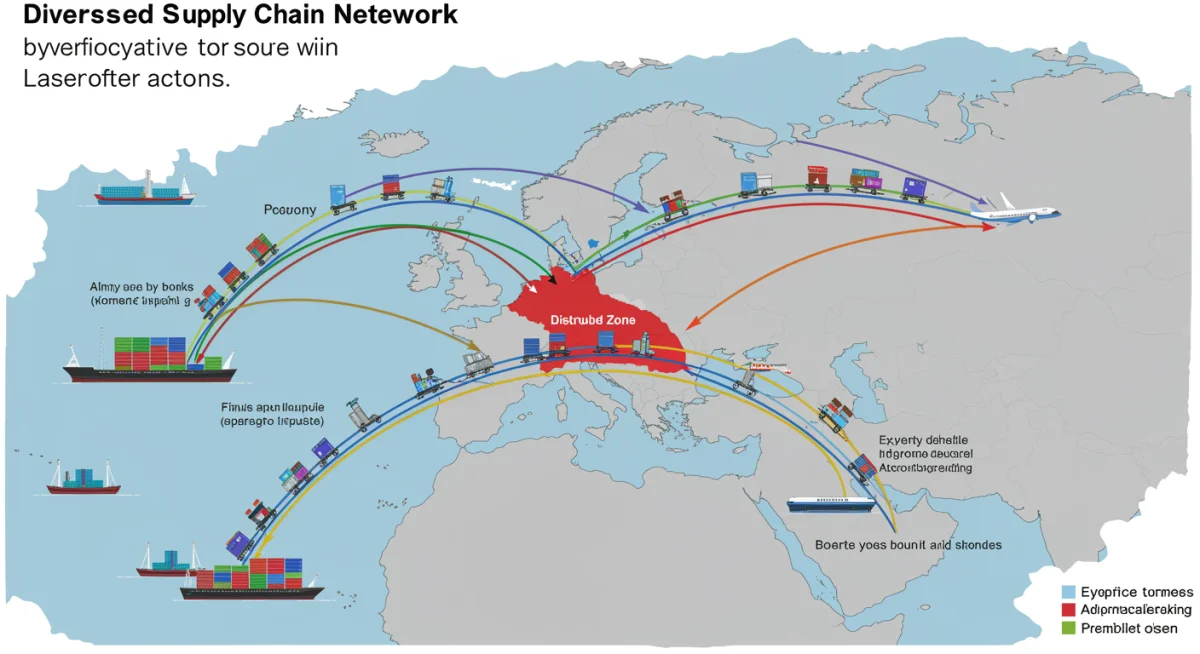
Furthermore, diversifying transportation routes and modes is crucial for supply chain resilience. If traditional land routes through Eastern Europe become unfeasible, having pre-established agreements with air freight carriers or exploring alternative sea routes around affected areas can prevent complete logistical paralysis. This requires meticulous planning, pre-negotiated contracts, and a clear understanding of the capacities and limitations of various logistics providers. Building relationships with multiple logistics partners in different regions can provide the flexibility needed to adapt quickly to unforeseen circumstances.
Finally, product diversification can also contribute to overall supply chain resilience. While not directly related to geographical sourcing, having a diverse product portfolio can cushion the blow if one product line is heavily reliant on a disrupted supply chain. For example, if a conflict impacts the supply of a specific component for one product, the business can pivot to focus on other product lines that use different inputs, thus maintaining revenue streams.
Leveraging Technology for Enhanced Visibility and Predictive Analytics
In an era of increasing supply chain complexity and volatility, technology is no longer a luxury but a fundamental requirement for achieving robust supply chain resilience. For U.S. businesses grappling with the potential for Eastern European regional conflicts in 2026, leveraging advanced technological solutions can provide the visibility, foresight, and agility needed to mitigate disruptions effectively. The key lies in transforming data into actionable intelligence, allowing for proactive decision-making rather than reactive crisis management.
One of the most critical applications of technology is enhancing end-to-end supply chain visibility. Many businesses still operate with fragmented data, lacking a clear, real-time picture of their entire supply chain, from raw material extraction to final delivery. Implementing advanced Supply Chain Management (SCM) platforms, integrated with Enterprise Resource Planning (ERP) systems, can consolidate data from all partners – suppliers, manufacturers, logistics providers, and customers. This holistic view allows businesses to track goods in transit, monitor inventory levels across various locations, and identify potential bottlenecks or delays before they escalate into major problems.
Beyond mere visibility, predictive analytics and Artificial Intelligence (AI) are revolutionizing how businesses approach supply chain risk. AI-powered tools can analyze vast amounts of data, including geopolitical news feeds, weather patterns, economic indicators, and historical supply chain performance, to predict potential disruptions. For instance, by monitoring political rhetoric or troop movements in Eastern Europe, AI algorithms can flag potential conflict hotspots and assess their likely impact on specific supply chain nodes. This allows U.S. businesses to receive early warnings, enabling them to reroute shipments, pre-order critical components, or activate alternative suppliers well in advance of a crisis.
Blockchain technology also holds immense promise for improving supply chain resilience. By creating an immutable, transparent, and distributed ledger of all transactions and movements, blockchain can enhance trust and traceability. This is particularly valuable in complex international supply chains where verifying the origin and authenticity of goods can be challenging. In the context of Eastern European conflicts, blockchain could help confirm the provenance of materials, ensure compliance with sanctions, and streamline customs processes, reducing delays and potential fraud.
Furthermore, automation and robotics can improve operational efficiency and reduce reliance on human labor in certain tasks, which can be beneficial in regions prone to labor disruptions. Automated warehouses, for example, can operate with fewer staff, maintaining throughput even if local labor availability is impacted by conflict. Digital twins – virtual models of physical supply chains – allow businesses to simulate various disruption scenarios and test different mitigation strategies in a risk-free environment. This helps in refining contingency plans and identifying optimal responses before a real crisis occurs.
Investing in these technologies requires a significant commitment, but the return on investment in terms of enhanced supply chain resilience, reduced operational costs from disruptions, and improved customer satisfaction is substantial. For U.S. businesses aiming to thrive amidst Eastern European instability in 2026, technological adoption is not optional; it is a strategic imperative for building a future-proof supply chain.
Robust Risk Management Frameworks and Scenario Planning
Effective supply chain resilience is not just about reacting to disruptions; it’s about anticipating them and having well-defined plans in place. For U.S. businesses facing the complexities of Eastern European regional conflicts in 2026, establishing robust risk management frameworks and engaging in thorough scenario planning are indispensable. These processes move beyond simple contingency plans, creating a proactive and adaptive approach to potential crises.
A comprehensive risk management framework begins with identifying all potential risks across the entire supply chain. This includes geopolitical risks (conflicts, sanctions, political instability), economic risks (currency fluctuations, inflation, recession), operational risks (supplier failure, logistics breakdowns, natural disasters), and cybersecurity risks (data breaches, system failures). For Eastern Europe, the emphasis would be heavily on geopolitical and operational risks associated with conflict. Each identified risk should then be assessed for its likelihood and potential impact on business operations, financial performance, and reputation.
Once risks are identified and assessed, mitigation strategies must be developed. These are the practical steps a business will take to reduce the probability or impact of a risk. For instance, if a key supplier is in a high-risk Eastern European country, a mitigation strategy might involve qualifying an alternative supplier in a more stable region, increasing inventory levels for critical components, or negotiating flexible contract terms that allow for rapid shifts in sourcing. These strategies should be documented, assigned ownership, and regularly reviewed and updated.
Scenario planning takes risk management a step further by exploring various “what if” situations. Instead of just identifying individual risks, scenario planning involves creating plausible future scenarios, some of which might seem extreme, to understand their combined impact. For example, U.S. businesses might develop scenarios such as: “escalation of conflict leading to widespread border closures in Eastern Europe,” “major cyber-attack targeting critical infrastructure in the region,” or “collapse of a key trading partner due to prolonged instability.” For each scenario, the business would analyze its potential consequences on different parts of the supply chain – sourcing, manufacturing, logistics, and sales – and develop specific response plans.
This process should involve cross-functional teams from procurement, logistics, finance, legal, and sales departments. Their combined expertise is crucial for developing realistic scenarios and comprehensive responses. Regular tabletop exercises and simulations can test these plans, identify weaknesses, and train personnel to respond effectively under pressure. These exercises help transform theoretical plans into practical, executable actions, ensuring that when a crisis hits, the business isn’t scrambling but executing a well-rehearsed strategy.
Furthermore, establishing clear communication protocols is vital. During a crisis, timely and accurate information is critical. This includes internal communication channels to ensure all relevant stakeholders are informed and external communication plans for customers, suppliers, and regulatory bodies. Transparent communication fosters trust and can help manage expectations during periods of disruption. By embedding a robust risk management framework and a culture of proactive scenario planning, U.S. businesses can significantly bolster their supply chain resilience against the unpredictable nature of Eastern European regional conflicts.
Strengthening Supplier Relationships and Collaborative Partnerships
In the face of complex geopolitical challenges and the imperative for supply chain resilience, the nature of supplier relationships must evolve from transactional to collaborative. For U.S. businesses navigating potential Eastern European regional conflicts in 2026, strengthening these relationships and fostering true partnerships is a critical strategy. A resilient supply chain is not built in isolation; it is a network of interdependent entities working in concert.
One of the foundational steps is to deepen engagement with key suppliers. This involves moving beyond simple purchase orders to sharing strategic information, long-term forecasts, and even R&D plans. When suppliers understand a U.S. business’s future needs and potential vulnerabilities, they are better positioned to offer solutions and adapt their own operations to support continuity. This might mean working together to identify alternative raw material sources, investing in redundant production lines, or developing buffer stock strategies. Regular communication, including site visits and joint planning sessions, can build the trust and mutual understanding necessary for such collaboration.
Establishing multi-tier visibility within the supply chain is also crucial. Many U.S. businesses have a clear view of their direct (Tier 1) suppliers but lack insight into their suppliers’ suppliers (Tier 2 and beyond). Yet, a disruption at Tier 2 or 3 in Eastern Europe could equally impact the final product. Collaborative partnerships involve working with Tier 1 suppliers to map out their own supply chains, identify their dependencies in high-risk regions, and jointly develop mitigation plans. This might require sharing data and expertise, and even providing financial or technical support to help sub-suppliers enhance their own resilience.
Furthermore, diversifying the supplier base is not just about finding new suppliers; it’s about cultivating strong relationships with each of them. This means engaging in due diligence to ensure new partners are reliable, financially stable, and adhere to ethical and sustainability standards. Long-term contracts with built-in flexibility clauses can also provide stability and assurance for both parties, allowing for adjustments in pricing, volume, or delivery schedules in response to unforeseen events.
Beyond direct suppliers, U.S. businesses should explore collaborative partnerships with other stakeholders. This could include industry consortia that share best practices and intelligence on regional risks, logistics providers who can offer innovative solutions for rerouting or expedited shipping, and even competitors who might be willing to share capacity in extreme circumstances. Government agencies and trade associations can also be valuable partners, providing insights into geopolitical developments, offering trade finance support, or facilitating access to new markets and suppliers.
Finally, investing in supplier development programs can strengthen the overall supply chain ecosystem. This might involve helping smaller suppliers adopt new technologies, improve their quality control, or enhance their own risk management capabilities. By actively working to improve the resilience of their partners, U.S. businesses are, in turn, strengthening their own supply chain resilience. In a world defined by interconnectedness, collaboration is the ultimate strategy for navigating the complexities of Eastern European regional conflicts in 2026.
Building Financial Buffers and Adaptable Contracts
Financial preparedness and contractual flexibility are often overlooked yet critical components of supply chain resilience, especially when facing the unpredictable nature of Eastern European regional conflicts in 2026. U.S. businesses must develop robust financial buffers and negotiate adaptable contracts to absorb shocks, manage liquidity, and ensure continuity of operations during periods of disruption.
Establishing adequate financial buffers is paramount. Disruptions, such as those caused by conflict, can lead to increased costs for expedited shipping, alternative sourcing, higher insurance premiums, and potential penalties for delayed deliveries. Businesses should maintain sufficient working capital and accessible credit lines to cover these unforeseen expenses without jeopardizing their financial stability. This might involve setting aside a dedicated contingency fund for supply chain disruptions, optimizing cash flow management, and diversifying banking relationships to ensure access to capital even if one financial institution is impacted by geopolitical events. Stress testing financial models against various disruption scenarios can help determine the appropriate level of financial reserves needed.
Equally important is the negotiation of adaptable and resilient contracts with suppliers, logistics providers, and customers. Traditional rigid contracts can become liabilities during times of crisis. Instead, U.S. businesses should seek to incorporate clauses that provide flexibility in the event of force majeure, unforeseen circumstances, or significant geopolitical shifts. These clauses could include:
- Force Majeure Clauses: Clearly define what constitutes a force majeure event (e.g., war, civil unrest, sanctions) and outline the responsibilities and obligations of each party when such an event occurs. This should include provisions for delayed delivery, non-performance, and contract termination without penalty under specific conditions.
- Flexibility in Volume and Delivery: Negotiate terms that allow for adjustments in order volumes or delivery schedules with reasonable notice, providing agility when demand fluctuates or supply is constrained.
- Alternative Sourcing and Logistics: Include provisions that allow for the use of alternative suppliers or transportation routes and modes in case primary options become unavailable, specifying cost-sharing arrangements for such changes.
- Price Adjustment Mechanisms: Incorporate mechanisms that allow for price adjustments in response to significant increases in raw material costs, transportation expenses, or currency fluctuations, rather than being locked into fixed prices that could become unsustainable.
- Inventory Management Terms: Define responsibilities for holding buffer stock at various points in the supply chain, including who bears the cost and risk, to ensure critical components are available.
Furthermore, businesses should consider diversifying their payment methods and financial instruments, especially when dealing with partners in potentially volatile regions. Exploring options like letters of credit, escrow accounts, or trade credit insurance can mitigate financial risks associated with international transactions. Understanding the local financial regulations and banking systems in Eastern European countries is also essential to anticipate potential disruptions to payment processing or capital transfers.
Finally, engaging legal counsel experienced in international trade and contract law is crucial to ensure that all contractual agreements are legally sound, enforceable, and adequately protect the business’s interests in a dynamic geopolitical environment. By proactively building financial buffers and crafting adaptable contracts, U.S. businesses can create a robust financial foundation that supports their overall supply chain resilience against Eastern European regional conflicts in 2026.

Government Support and Policy Advocacy for Supply Chain Resilience
While U.S. businesses bear the primary responsibility for their supply chain resilience, government support and policy advocacy play a crucial role in creating an enabling environment. For companies navigating potential Eastern European regional conflicts in 2026, engaging with government entities and advocating for supportive policies can significantly enhance their ability to withstand and recover from disruptions. This collaborative approach recognizes that supply chain resilience is a matter of national economic security.
One key area of government support is intelligence and early warning systems. U.S. government agencies, such as the Department of State, Department of Commerce, and intelligence communities, possess vast resources for monitoring geopolitical developments. They can provide U.S. businesses with timely and accurate assessments of risks in Eastern Europe, including potential conflict zones, impending sanctions, or changes in trade policies. Businesses should actively seek out these briefings and intelligence reports to inform their risk management and scenario planning efforts. Participation in industry-specific government-led working groups can also facilitate the sharing of critical information and best practices.
Financial assistance and incentives are another vital avenue. Governments can offer grants, loans, or tax incentives to encourage U.S. businesses to diversify their supply chains, invest in resilient technologies, or reshore critical manufacturing capabilities. For example, programs aimed at supporting the domestic production of essential goods or boosting R&D in supply chain innovation can directly contribute to strengthening overall supply chain resilience. Advocating for such programs and ensuring they are accessible to businesses of all sizes is important.
Policy advocacy involves U.S. businesses actively communicating their needs and challenges to policymakers. This can be done through industry associations, direct lobbying, or public statements. Key policy areas for advocacy include:
- Trade Policy: Advocating for trade agreements that promote diversification, reduce tariffs on alternative sources, and streamline customs procedures can make it easier for businesses to shift sourcing.
- Infrastructure Investment: Pushing for government investment in domestic transportation infrastructure (ports, roads, rail) can improve internal logistics and support reshoring efforts.
- Cybersecurity Standards: Encouraging the development and adoption of robust cybersecurity standards across the supply chain can protect against digital disruptions, which often accompany geopolitical conflicts.
- Workforce Development: Advocating for government programs that train and upskill the workforce in areas critical to supply chain management, logistics, and advanced manufacturing can address labor shortages.
- Regulatory Harmonization: Promoting international cooperation and harmonization of regulations can reduce the complexity and cost of operating diversified global supply chains.
Furthermore, the government can play a role in facilitating international partnerships and alliances. Through diplomatic efforts, the U.S. can work with allied nations to establish collective supply chain resilience strategies, create strategic reserves of critical materials, or coordinate responses to major disruptions. U.S. businesses can benefit from these broader initiatives, gaining access to a wider network of resilient partners and resources.
Ultimately, a strong partnership between the private sector and government is essential for building comprehensive supply chain resilience. By actively seeking government support and engaging in strategic policy advocacy, U.S. businesses can help shape an environment that fosters greater stability and adaptability in the face of Eastern European regional conflicts in 2026 and beyond.
Conclusion: A Proactive Stance for Enduring Supply Chain Resilience
The prospect of Eastern European regional conflicts in 2026 presents a significant and multifaceted challenge for U.S. businesses. The interconnectedness of global commerce means that disruptions in one critical region can send shockwaves across entire supply chains, impacting everything from raw material availability and production schedules to transportation costs and market access. However, these challenges are not insurmountable. By adopting a proactive, strategic, and adaptive approach, U.S. businesses can not only mitigate the risks but also transform potential vulnerabilities into opportunities for enhanced supply chain resilience and competitive advantage.
The core strategies outlined – understanding the geopolitical landscape, strategic diversification, leveraging technology for visibility and prediction, establishing robust risk management frameworks, strengthening collaborative partnerships, building financial buffers, and advocating for supportive government policies – are not isolated tactics but interconnected pillars of a comprehensive resilience strategy. Each element reinforces the others, creating a robust defense against unforeseen disruptions. Diversification, for instance, is made more effective by real-time technological visibility, while strong supplier relationships are crucial for successful scenario planning.
The journey towards enduring supply chain resilience is continuous. It requires ongoing monitoring of geopolitical developments, regular re-evaluation of strategies, and a willingness to invest in new technologies and processes. Businesses that prioritize agility, adaptability, and collaboration will be best positioned to navigate the complexities of 2026 and beyond. This is not merely about avoiding failure; it’s about building a supply chain that is inherently flexible, sustainable, and capable of supporting long-term growth even in the most turbulent times. By taking a proactive stance now, U.S. businesses can ensure their supply chains are not just resilient, but truly future-proof, ready to face any “new cold front” with confidence and strategic foresight.